
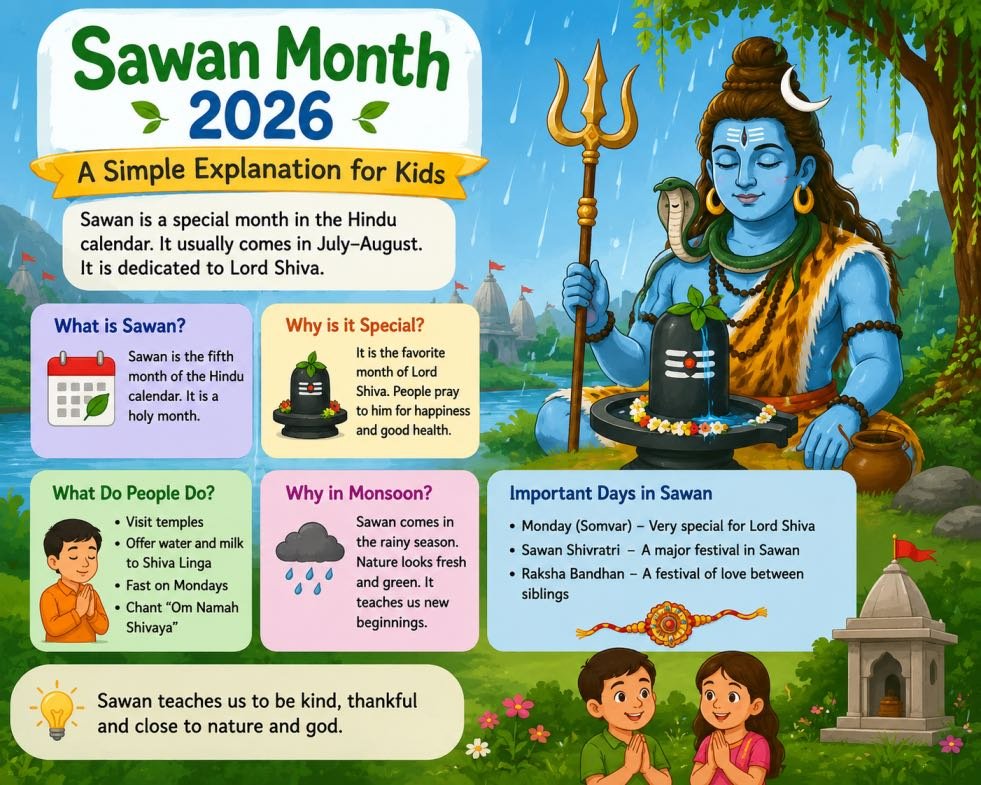
Sawan Month 2026: A Simple Explanation for Kids
My daughter’s question this year was refreshingly direct: why does everyone suddenly start talking about Mondays being special the moment Sawan begins? It’s a fair question, and one I hadn’t actually explained clearly to her before, mostly assuming she’d absorb the meaning over time without a real conversation about it.
Here’s Sawan month 2026, a simple explanation for kids, covering both the practical dates and the actual story behind why this particular month matters so much.
| Quick Answer: Sawan (Shravan) 2026 runs from Thursday, July 30 to Friday, August 28 in North India, with four Sawan Mondays falling on August 3, 10, 17, and 24. The month is dedicated to Lord Shiva and is considered especially sacred, tied to the story of Samudra Manthan and Shiva drinking poison to protect the world. |
When Sawan 2026 Actually Falls
In North India, Sawan 2026 begins on Thursday, July 30, and continues through Friday, August 28, following the Purnimanta calendar. Families in Maharashtra, Gujarat, and much of South India, who follow the Amanta calendar, observe Shravan on a slightly different, later window, so it’s worth checking your own region’s specific dates rather than assuming they match exactly.
Why the Month Is Considered So Special
The Story Behind It
Sawan’s significance traces back to the story of Samudra Manthan, the churning of the cosmic ocean, during which a dangerous poison emerged that threatened to harm the whole world. Lord Shiva drank the poison himself to protect everyone else, and it’s said to have turned his throat blue, which is why he’s sometimes called Neelkanth.
Why Mondays Specifically Matter
Mondays throughout Sawan are considered especially significant for worshipping Shiva, and this year’s four Sawan Mondays fall on August 3, 10, 17, and 24, days many families mark with a Shiva puja or a simple fast.
Practical Tips
- Check your specific region’s calendar tradition, since North and South India observe slightly different Sawan windows.
- Keep the Samudra Manthan explanation simple and age-appropriate for younger kids, focusing on the idea of Shiva protecting others.
- Mark the four Sawan Mondays on a family calendar if your household observes them, so kids know what to expect each week.
- Follow up a factual explanation with a simple, honest conversation about what the story actually means, not just the dates.
Key Takeaways
- Sawan 2026 runs from July 30 to August 28 in North India, with four Mondays considered especially significant.
- The month’s significance ties back to the story of Samudra Manthan and Shiva protecting the world by drinking poison.
- Regional calendar differences mean South and West India observe a slightly later Shravan window.
- A simple, age-appropriate version of the underlying story helps kids understand the month’s meaning, not just its dates.
Conclusion
Explaining both the practical dates and the actual story behind Sawan gives kids a fuller, more genuine understanding of the month than the dates alone ever could. Keep the explanation simple and age-appropriate, and build on it gradually as your child gets older and asks more detailed questions.
Also Read:
Best Lord Shiva Stories for Kids: Fun, Inspiring & Easy-to-Read Tales
Sawan Somvar Vrat Katha for Kids: A Simple & Easy Story to Understand
5 Simple Sawan Mehndi Designs for Kids: Easy & Cute Ideas
When does Sawan start in 2026?
In North India, Sawan 2026 begins on Thursday, July 30, and ends on Friday, August 28, following the Purnimanta calendar.
How many Sawan Mondays are there in 2026?
There are four Sawan Mondays in North India’s 2026 calendar, falling on August 3, 10, 17, and 24.
Why is Sawan associated with Lord Shiva?
Sawan’s significance ties back to the story of Samudra Manthan, during which Shiva drank a dangerous poison to protect the world, an act of sacrifice devotees honor especially during this month.
Do all regions in India observe Sawan on the same dates?
No, North India follows the Purnimanta calendar while Maharashtra, Gujarat, and much of South India follow the Amanta calendar, resulting in a somewhat different, later observed window for the same month.






One Comment
Comments are closed.