
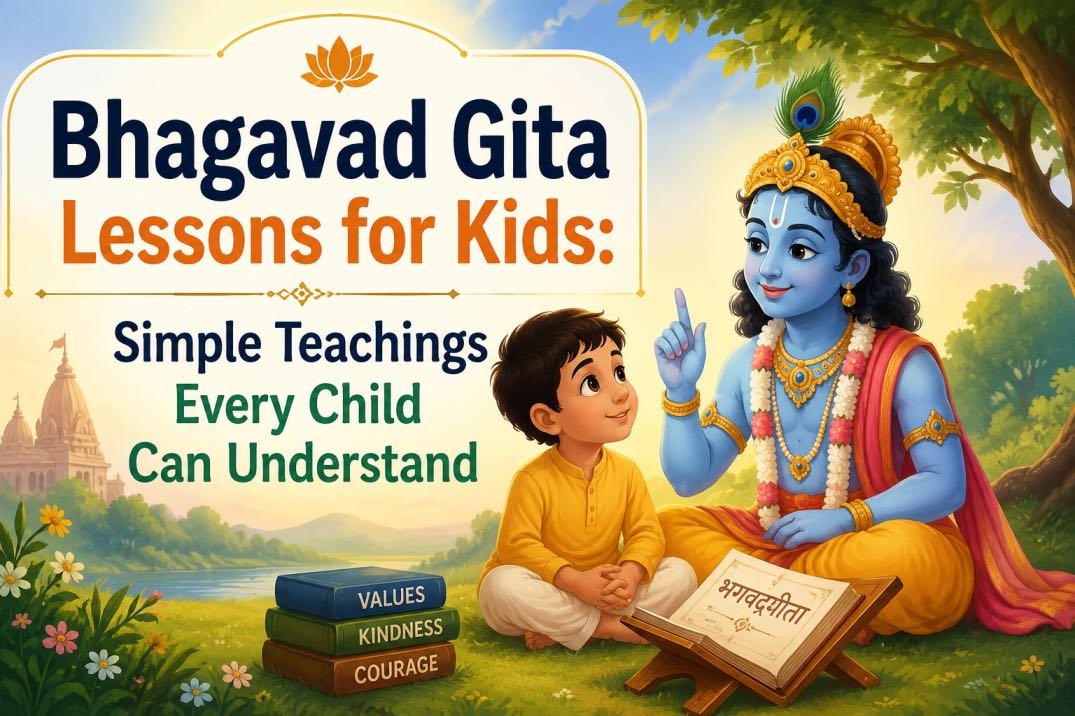
Bhagavad Gita Lessons for Kids: Simple Teachings Every Child Can Understand
Quick answer: Simplified for kids, key Bhagavad Gita lessons include doing your best without obsessing over the outcome, staying calm during difficulty, treating others fairly regardless of differences, and understanding that fear and doubt are normal but shouldn’t stop you from doing what’s right. Here are a few lessons broken down simply.
Lessons Explained Simply
1. Focus on Effort, Not Just the Result — One of the Gita’s most well-known teachings is about doing your duty and putting in genuine effort without becoming overly attached to a specific outcome. For kids, I’ve translated this into simply doing their best on something, like a test or a match, without spiraling if the result isn’t exactly what they hoped for.
2. Staying Calm in Difficult Moments — The Gita speaks about maintaining inner steadiness even amid chaos and difficulty. With my own kids, I’ve connected this to staying calm during a frustrating homework problem or an argument with a friend, rather than immediately reacting with big, overwhelming emotions.
3. Everyone Has a Role to Play — The idea that each person has their own duty and path, and that comparing yourself constantly to others isn’t useful, translates well into helping kids understand that their own strengths and interests matter, even if they’re different from a friend’s or sibling’s.
4. Fear and Doubt Are Normal, But Shouldn’t Stop You — Arjuna’s own fear and hesitation before battle, and Krishna’s guidance through that fear, offers a genuinely relatable lesson for kids: feeling scared or unsure before something difficult is completely normal, and doesn’t mean you shouldn’t still try.
| Lesson | How I’ve Explained It to Kids |
| Effort over outcome | Do your best, don’t spiral over the result |
| Staying calm in difficulty | Take a breath instead of reacting immediately |
| Everyone has their own path | Your strengths matter, even if different from others’ |
| Fear is normal | Being scared doesn’t mean you shouldn’t try |
Fast Tips
- Keep explanations simple and tied to a child’s own real experiences, rather than abstract philosophical language.
- Introduce one lesson at a time rather than trying to cover the Gita’s full scope at once.
- Use a specific, relatable moment, a test, a scary first day, to make each lesson concrete for a child.
- Revisit these lessons naturally when a relevant real situation comes up, rather than only during a formal lesson.
Is the Bhagavad Gita appropriate to introduce to young kids?
The full text involves complex philosophical and spiritual concepts, but its core lessons can be genuinely simplified and made age-appropriate for kids without losing their essential meaning.
What is a simple Gita lesson to start with for a child?
The idea of focusing on genuine effort rather than obsessing over a specific outcome tends to be one of the most relatable and immediately useful lessons to introduce first.
How can I make Gita lessons feel relevant to a child’s everyday life?
Connecting a lesson to a specific, real situation your child is facing, like fear before a test or frustration during a difficult task, makes an otherwise abstract teaching feel genuinely applicable.





2 Comments