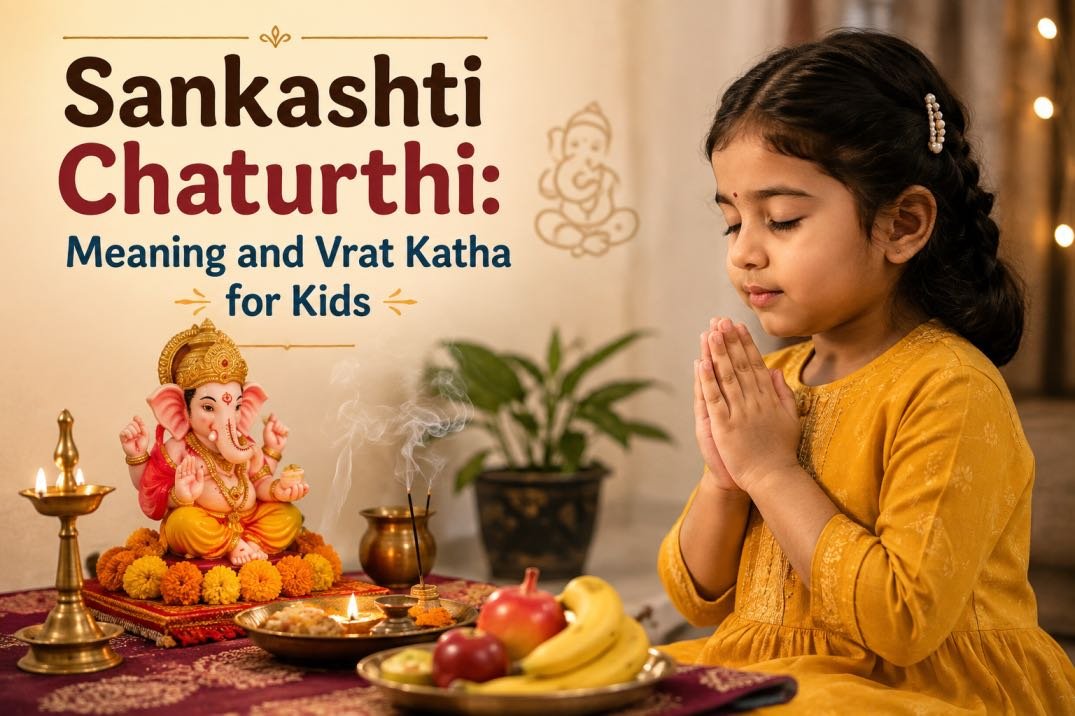
Sankashti Chaturthi: Meaning and Vrat Katha for Kids
Quick answer: Sankashti Chaturthi is a monthly Hindu observance dedicated to Lord Ganesha, falling on the fourth day of the waning moon (Krishna Paksha) each month. The word “Sankashti” means relief from difficulty, and devotees fast and pray to Ganesha, the remover of obstacles, for help overcoming challenges. Here’s a simplified version of the meaning and story I’ve actually shared with my own kids.
My son first asked about Sankashti Chaturthi when he noticed his grandmother fasting on a specific day that didn’t match any festival he already knew about, genuinely puzzled that this wasn’t a once-a-year occasion like the festivals he was used to.
Explaining that this particular observance actually happens every single month, tied to the moon’s cycle rather than a fixed date, was itself a small, interesting lesson for him about how many Hindu observances follow the lunar calendar rather than a single yearly date.
What Sankashti Chaturthi Actually Means
The name breaks down simply: “Sankashti” means relief from difficulty or hardship, and “Chaturthi” refers to the fourth day of the lunar cycle, specifically the fourth day after the full moon, during the waning phase. Put together, the day is dedicated to seeking Lord Ganesha’s help in removing obstacles and difficulties, which is fitting given Ganesha’s broader role as the remover of obstacles across Hindu tradition.
I’ve explained to my kids that this is really why the day comes around monthly rather than annually, since the idea is to regularly, consistently seek help and reflect on challenges, rather than marking one single yearly moment, similar in spirit to how a weekly or monthly habit builds something a once-a-year occasion can’t quite manage on its own.
A Simplified Vrat Katha for Kids
One traditional story tells of a king who was troubled by a persistent difficulty in his kingdom, and after observing the Sankashti Chaturthi vrat with genuine devotion, praying sincerely to Lord Ganesha, found his troubles gradually resolved, not through a single dramatic miracle, but through the steady clarity and resolve his devotion seemed to bring him.
I keep this story simple for my kids, focusing on the idea that the king didn’t just wish his problem away, he committed to something consistent and genuine, and that persistence, paired with sincere effort, is really what the story is pointing toward, not a shortcut or an instant fix.
My daughter, hearing this story, connected it to her own experience preparing for a school exam, saying that steady, repeated effort felt similar to what the king in the story had done, which told me the core idea had landed in a way that felt genuinely relevant to her own life, not just a distant religious tale.
Parent Tip
Parent Tip: If your child notices a family member observing Sankashti Chaturthi and asks why it’s not an annual festival like others they know, use it as a simple opportunity to explain how many Hindu observances follow the lunar calendar monthly, not just once a year.
Quick Comparison
| Element | What It Represents |
| “Sankashti” (relief from difficulty) | The day’s core purpose: seeking help through hardship |
| Monthly observance | Consistent, regular reflection rather than a single yearly moment |
| The king’s story | Steady, genuine devotion resolving difficulty over time |
| Fasting until moonrise | A traditional practice of discipline paired with prayer |
Practical Tips
- Keep the vrat katha simple and focused on the core idea of steady devotion, rather than every traditional detail at once.
- Explain the monthly, lunar-calendar timing if your child is used to thinking of festivals as yearly occasions.
- Connect the story’s theme of persistence to something concrete in your child’s own life, like exam preparation or practicing a skill.
- Let older kids ask about the fasting practice itself if they’re curious, without pressuring them to participate if your family doesn’t observe it.
Common Mistakes to Avoid
- Assuming a child already understands that some observances are monthly rather than annual, without explaining the lunar calendar basis.
- Overloading the story with every traditional detail at once instead of keeping the core lesson simple and memorable.
- Not connecting the story’s theme to something concrete in a child’s own life, which can make the lesson feel distant rather than genuinely relevant.
The Short Version
Sankashti Chaturthi, a monthly observance dedicated to Lord Ganesha as the remover of obstacles, is genuinely explainable to kids through its name’s meaning and a simple vrat katha about steady, sincere devotion resolving difficulty over time, a lesson that connects well to a child’s own experience of persistence with schoolwork or new skills.
Related Reading on PlayAndGrow
Bhagavad Gita lessons for kids
Our Guru Purnima vrat katha for kids, simplified
Sawan Somvar vrat katha for kids, simplified
Why do we celebrate Guru Purnima, another explainer
FAQs
What does Sankashti Chaturthi actually mean?
“Sankashti” means relief from difficulty, and “Chaturthi” refers to the fourth day of the lunar cycle, together marking a monthly day dedicated to seeking Lord Ganesha’s help in overcoming obstacles.
Why does Sankashti Chaturthi happen every month instead of once a year?
It’s tied to the lunar calendar, falling on the fourth day of the waning moon each month, reflecting a tradition of regular, consistent devotion rather than a single yearly observance.
What is the moral of the Sankashti Chaturthi vrat katha?
The story teaches that steady, sincere devotion and persistence, rather than a single dramatic wish or shortcut, is what genuinely helps resolve difficulty over time.
Is Sankashti Chaturthi the same as Ganesh Chaturthi?
No, Ganesh Chaturthi is a major annual festival celebrating Lord Ganesha’s birth, while Sankashti Chaturthi is a separate, monthly observance dedicated to seeking his help with obstacles.