
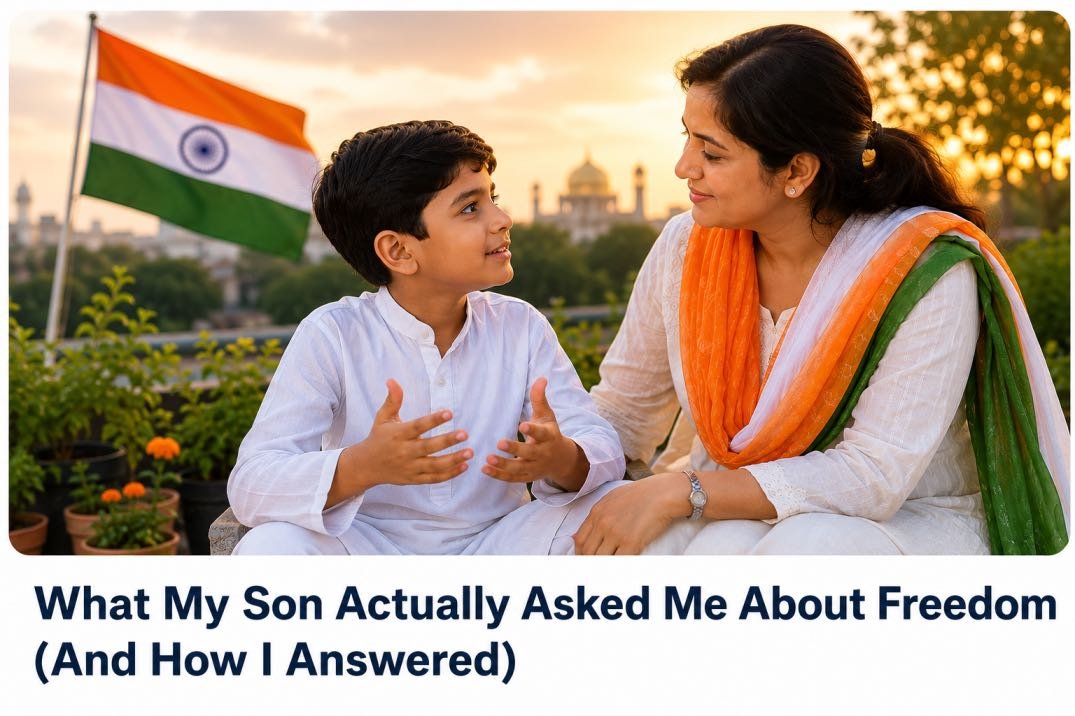
What My Son Actually Asked Me About Freedom (And How I Answered)
Quick answer: Kids often ask surprisingly direct questions about freedom around Independence Day, like why India wasn’t free before, or what freedom actually means day to day, and answering honestly in age-appropriate language tends to land better than either oversimplifying or overwhelming them with historical detail. My son’s first question, a few days before Independence Day last year, caught me off guard with how direct it was: why wasn’t India free before, and what happened to make it free.
I realized I’d been assuming he understood the basic concept already, simply because he’d sung patriotic songs and made tricolor crafts at school for years, without anyone actually sitting down to explain what the day was fundamentally about.
Working through his questions honestly, without either dumbing the answers down to the point of being meaningless or overwhelming him with more historical detail than he could process, turned into a genuinely worthwhile conversation.
The Questions That Actually Came Up
“Why wasn’t India free before?” led to a simple explanation that another country, Britain, had ruled India for a long time, making many decisions for Indians without their say, which he connected to a relatable idea: imagine someone else deciding everything about your day without asking you.
“What does being free actually mean?” was harder to answer simply, and I ended up describing it as India’s people getting to make their own decisions about their own country, rather than someone far away deciding for them, which seemed to genuinely click for him in a way a more abstract definition hadn’t.
“Did people have to fight?” opened into a brief, age-appropriate mention that many people worked hard and made real sacrifices, some through peaceful protest and some through more direct struggle, without going into graphic detail he wasn’t ready for.
A follow-up question, whether it could happen again, that India could lose its freedom, genuinely surprised me, and I answered honestly that freedom isn’t automatic or permanent, it’s something a country’s people have to keep caring about and participating in, through things like voting when he’s older, and simply staying informed and engaged even now in small ways.
What I Learned From Answering Honestly
Simplifying the answers didn’t mean avoiding the real substance of what happened, it meant finding language and comparisons he could genuinely connect with, like the idea of someone else deciding your day for you, rather than either a watered-down non-answer or an overwhelming history lecture.
I also learned that he was capable of holding more nuance than I’d initially assumed, once the ideas were presented at his level, and that treating his questions seriously, rather than deflecting with a quick, surface answer, genuinely deepened his interest in the day beyond just the songs and crafts.
What surprised me most, looking back, was how much this one conversation shaped the rest of his Independence Day that year. He brought up the comparison about someone else deciding his day for him again, unprompted, during a completely unrelated moment weeks later, which told me the idea had genuinely stuck rather than just being information he’d absorbed and forgotten.
Parent Tip
Parent Tip: When a child asks a big question like this, resist the urge to give either an overly simple non-answer or a full history lecture. Find one relatable comparison, like someone else deciding your day for you, that captures the real idea at their level.
Quick Comparison
| Question | How I Answered |
| Why wasn’t India free before? | Another country made decisions for Indians without their say |
| What does being free mean? | India’s people get to make their own decisions now |
| Did people have to fight? | Many made real sacrifices, some peaceful, some more direct |
Practical Tips
- Use a relatable comparison, like someone else deciding your day, to make an abstract concept concrete for a child.
- Answer honestly rather than deflecting, even if a question feels like it requires more nuance than expected.
- Keep historical detail age-appropriate, without avoiding the real substance of what happened.
- Let the conversation follow your child’s actual questions rather than delivering a planned lecture.
Common Mistakes to Avoid
- Assuming a child already understands basic concepts like freedom simply because they’ve participated in related school activities for years.
- Giving an overly simple non-answer that avoids the real substance of the question.
- Overwhelming a young child with more graphic historical detail than they’re developmentally ready for.
The Short Version
My son’s direct questions about why India wasn’t free before, and what freedom actually means, pushed me to find honest, age-appropriate answers built around relatable comparisons, rather than either oversimplifying or overwhelming him with historical detail, and the conversation ended up genuinely deepening his interest in the day.
Related Reading on PlayAndGrow
our Independence Day speech guide for kids, age-wise
our Guru Purnima story with moral for kids, another honest conversation starter
our Independence Day wishes and messages for family and kids
our Independence Day homework help guide, common questions answered
FAQs
How do I explain freedom to a young child?
Using a relatable comparison, like someone else deciding your entire day without asking you, tends to make the abstract concept of freedom concrete and understandable for a young child.
Should I avoid historical detail when talking to kids about Independence Day?
Not entirely — keeping detail age-appropriate while still conveying real substance, rather than avoiding the topic altogether, tends to build genuine understanding without overwhelming a child.
What if my child asks a question I don’t know how to answer simply?
Taking a moment to find one relatable comparison that captures the real idea, rather than either deflecting or overwhelming them with detail, tends to work better than answering immediately without thinking it through.


One Comment
Comments are closed.