

Guru Purnima Story with Moral for Kids
Quick answer: The story of Eklavya, who taught himself archery by practicing before a clay statue of his guru Dronacharya, is a classic Guru Purnima story about devotion, respect, and the depth of the guru-student bond, even without direct instruction. Every Guru Purnima, once my kids are done making their cards, I sit them down and tell this particular story, because it captures something about respecting a teacher that no explanation ever quite manages on its own.
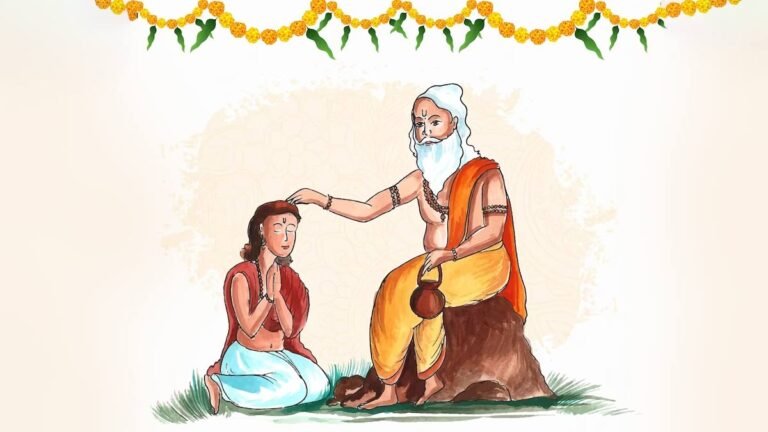
The story goes that a young boy named Eklavya, from a hunting community, deeply wanted to learn archery from the great teacher Dronacharya, who trained the royal princes of his time. When Eklavya approached him, Dronacharya turned him away, since he had already committed to teaching only the princes. Rather than giving up, Eklavya went into the forest, built a clay statue of Dronacharya, and practiced in front of it every single day, treating the statue with the same respect and devotion he would have given a real teacher physically present with him.
Through years of disciplined, solitary practice, guided only by his memory of Dronacharya’s teachings and his own imagined sense of the guru’s guidance, Eklavya became an archer of extraordinary skill, eventually surpassing even Dronacharya’s own royal students. When Dronacharya later discovered this and saw Eklavya’s remarkable skill, he was astonished, and the story that follows involves a difficult and much-debated request Dronacharya makes of Eklavya as guru-dakshina, a traditional gesture of gratitude to one’s teacher.
Why I Tell This Particular Story
I’ve chosen this story over some of the other Guru Purnima tales specifically because of what it says about devotion and respect existing independent of direct, constant instruction. Eklavya never received a single lesson from Dronacharya in person, yet his respect for him, and his discipline in practicing as if guided by him, produced genuinely extraordinary results. When I tell this to my kids, I emphasize that respect for a teacher isn’t really about how much time they spend with you, it’s about how seriously you take what they’ve taught you and how much effort you put into honoring that.
My daughter, hearing this story, connected it immediately to online classes she’d had during a period when her regular teacher wasn’t available, asking whether she could show the same kind of respect and effort toward a teacher she wasn’t seeing in person every day. That’s really the heart of why this particular story has stuck with our family’s Guru Purnima tradition, it opens a genuine conversation about what respecting a teacher actually means, beyond just physical presence in a classroom.
How I Handle the Complicated Part of the Story
The traditional ending of this story, involving Dronacharya’s difficult request of Eklavya, is genuinely complicated and raises real questions about fairness that I don’t think should be glossed over for the sake of a tidy moral. With my older daughter, I’ve talked honestly about how the story reflects certain ideas from its time that we can question and discuss, rather than presenting it as an unquestionable model to follow exactly as told.
With my younger son, I’ve kept the focus more squarely on Eklavya’s dedication and the extraordinary results of his disciplined practice, without going deeply into the more difficult final part of the story, since that nuance felt like something better suited to an older child who can genuinely engage with its complexity rather than just absorbing it uncritically.
| Age Group | How to Tell This Story |
| Under 7 | Focus on Eklavya’s dedication and practice, skip the complex ending |
| 7-10 | Include the full story with a simple, guided discussion of the ending |
| 11+ | Discuss the story’s complexity and fairness questions openly |
The Short Version
The story of Eklavya’s devotion to his guru, even without direct instruction, offers a genuinely rich way to talk with kids about respect, discipline, and what honoring a teacher actually means, though the story’s more complicated ending is worth handling thoughtfully and age-appropriately rather than glossed over.
Related Reading on PlayAndGrow
Guru Purnima Teacher Appreciation Activities for Kids
Guru Purnima Speech for School Students (Nursery to Class 10)
Guru Purnima Quotes for Children
Guru Purnima Essay for Students (100, 200, 500 Words)
Why Do We Celebrate Guru Purnima? (For Kids)
Guru Purnima Wishes and Thank You Messages for Teachers
Guru Purnima Poems for Kids
Guru Purnima Celebration Ideas at School
Guru Purnima Gift Ideas for Teachers Under a Budget
Guru Purnima Drawing Ideas for Kids
What is the moral of the Eklavya story?
The story teaches that genuine devotion and disciplined effort toward what a teacher represents can produce extraordinary results, even without constant direct instruction, though its full ending also raises complex questions about fairness worth discussing with older kids.
Is the Eklavya story appropriate for young children?
The core story of dedication and practice works well for young children, though the more complex final part of the traditional tale is generally better suited to an older child who can engage with its nuance.
Why is this story often told on Guru Purnima?
It’s a classic example of guru-shishya devotion in Indian tradition, illustrating deep respect for a teacher’s guidance and the transformative power of disciplined practice.



One Comment