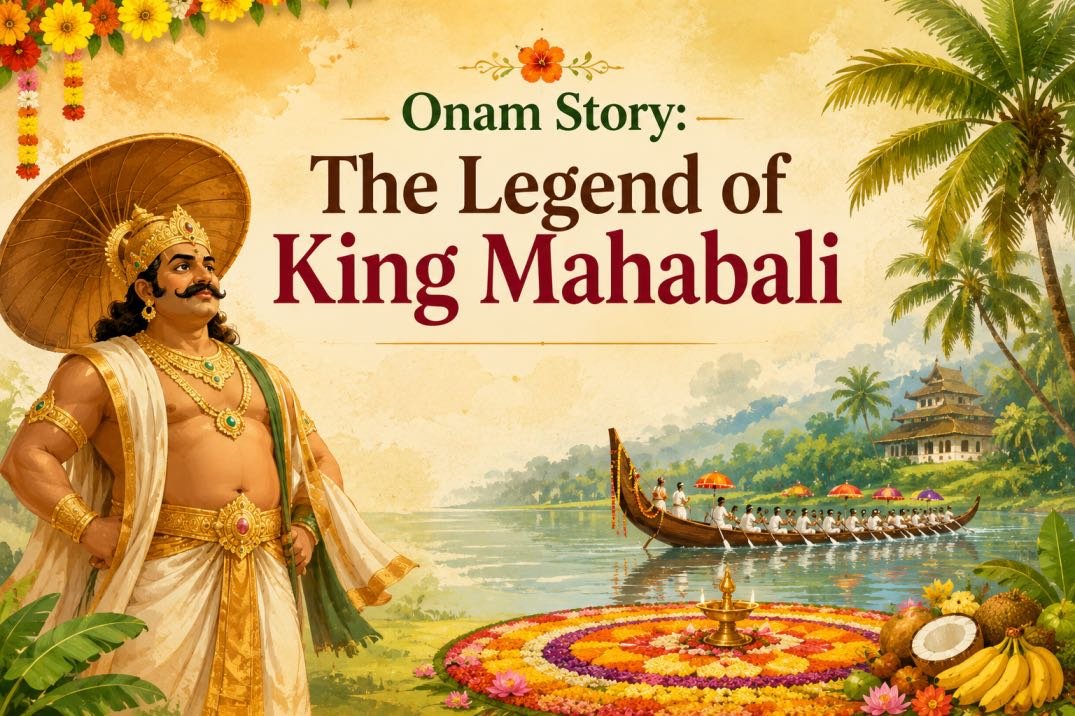
Onam Story: The Legend of King Mahabali
The question I get asked most: “Why does Onam celebrate a king who technically lost his kingdom?”
This confused my daughter too the first time I told her the story, since it does seem like an unusual thing to celebrate at first. The actual answer, once she understood the full story, is that Onam celebrates Mahabali not for losing, but for being such a genuinely good and beloved king that his people wanted him to return every single year, and that’s exactly what the festival marks.
Q: How does the story of King Mahabali actually go?
King Mahabali was a generous, much-loved ruler under whom his kingdom genuinely flourished, with prosperity and fairness for everyone, so much so that the gods began to worry his growing power might upset the balance of the universe. Lord Vishnu took the form of a small, humble boy named Vamana and visited Mahabali, asking for just three paces of land as a gift, a request the generous king happily granted without hesitation.
Q: What happened once Mahabali granted the request?
Vamana then grew to an enormous size, covering the entire earth with his first step and the whole sky with his second, leaving no space at all for a third step. True to his word and his generous nature, Mahabali offered his own head for Vamana’s final step, choosing to honor his promise even at great personal cost, which deeply moved Vishnu.
Q: Why is this considered a happy story rather than a sad one?
Moved by Mahabali’s humility and honesty, Vishnu granted him a special blessing, that he could return to visit his beloved kingdom and people once every year. Onam marks the celebration of that annual homecoming, which is why the festival, rather than being sad about Mahabali’s loss, is actually a joyful welcome for a king so good that even after being humbled, he was given the gift of returning to see his people thrive.
Q: What’s the lesson kids typically take from this story?
My own kids have taken away a genuine appreciation for keeping promises even when it’s difficult, since Mahabali’s willingness to honor his word despite the personal cost is really the heart of why he’s remembered so fondly. It’s also a gentle way to talk about humility and generosity without the conversation feeling like a lecture, since the story itself carries the lesson naturally.
| Story Element | What It Represents |
| Mahabali’s generosity as king | Fair, prosperous rule beloved by his people |
| Vamana’s three steps | A test of honesty and humility |
| Mahabali’s sacrifice | Keeping a promise even at great personal cost |
| The annual return | Onam’s yearly, joyful homecoming celebration |
Bottom Line
The Onam story of King Mahabali is ultimately a joyful one, celebrating a genuinely good, generous king so beloved by his people that he was granted the gift of returning to visit them every year, and it offers a gentle, natural way to talk with kids about honesty, humility, and keeping promises without the conversation feeling like a forced lesson.
Related Reading on PlayAndGrow
Our Onam celebration ideas for kids, including pookalam projects
Easy Onam-inspired snacks for kids
A Few More Quick Questions
Who is Vamana in the Onam story?
Vamana is the humble, small form Lord Vishnu took to visit King Mahabali and test his generosity and humility by requesting just three paces of land.
What do people do to celebrate Mahabali’s annual return during Onam?
Families create flower arrangements called pookalams, prepare a traditional feast, and celebrate with various activities and festivities to welcome King Mahabali’s yearly visit.