Best Books Every Child Should Read (Age-wise)
I used to rely heavily on generic “best books for kids” lists online, which often mixed books meant for wildly different ages together, leading to a fair number of mismatched choices that either bored or overwhelmed my kids depending on which end of the list I picked from.
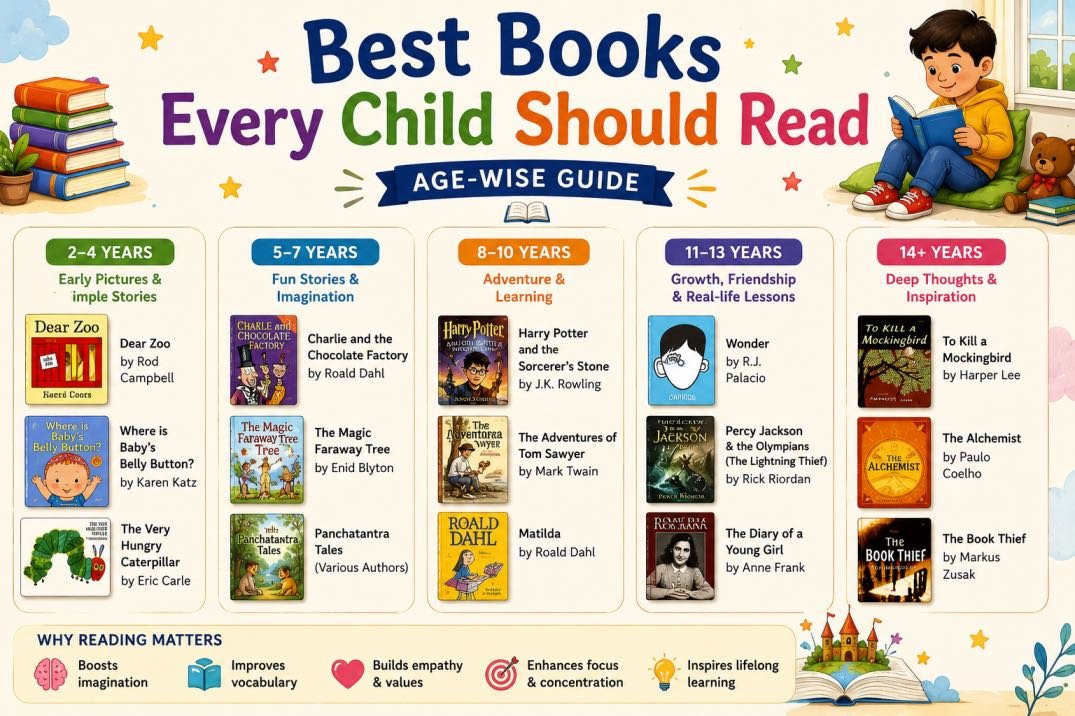
Here are the best books every child should read, age-wise, organized specifically by what’s actually held up to real reading sessions at each stage, rather than a single undifferentiated list.
| Quick Answer: Good age-wise book choices for kids include picture books with repetitive, simple language for ages 2-4, early chapter books with strong illustrations for ages 5-7, longer chapter book series for ages 8-10, and books with more complex themes and character depth for ages 11 and up. Matching book complexity to actual reading stage matters more than a fixed “must-read” list. |
Why Age-Wise Organization Matters More Than a Generic List
A single “best books” list spanning many ages often leads to real mismatches, a book too simple to hold an older child’s interest, or one too complex for a younger child to genuinely follow, both of which can discourage reading engagement rather than build it.
Recommendations by Age Stage
Ages 2-4
Simple picture books with repetitive, predictable language and strong, colorful illustrations work best, since the repetition itself supports early language development and gives a toddler a comforting sense of familiarity.
Ages 5-7
Early chapter books with heavy illustration support and shorter chapters help bridge the gap between picture books and longer, purely text-based stories.
Ages 8-10
Longer chapter book series, offering both a satisfying single story and the appeal of continuing with beloved characters across multiple books, tend to build strong, sustained reading habits.
Ages 11+
Books exploring more complex themes, deeper character development, and genuine emotional or moral complexity suit this age’s growing capacity for nuanced understanding.
Practical Tips
- Match book choices to your child’s actual current reading stage, not just their age on paper.
- Let your child re-read favorites as often as they want, since repetition genuinely supports comprehension and comfort.
- Mix independent reading with some books read aloud together, even for older kids who can read alone.
- Follow genuine interest, a specific topic or genre your child loves, over a generic “must-read” list.
Key Takeaways
- Matching book complexity to a child’s actual reading stage matters more than following a single generic “best books” list.
- Picture books with repetitive language suit early ages, while chapter book series build sustained reading habits in middle childhood.
- Older kids benefit from books with genuine thematic and emotional complexity, not just longer page counts.
- Following genuine individual interest tends to build stronger reading engagement than a fixed, generic reading list.
Conclusion
The best book for a child is ultimately the one that genuinely matches their current reading stage and interests, not necessarily the one topping a generic list. Use these age-wise categories as a starting point, and let your child’s actual engagement guide where you go from there.
Related Reading on PlayAndGrow
how to support a child who dislikes reading
our best educational youtube channels for kids
FAQs
What books are good for a 3-year-old?
Simple picture books with repetitive, predictable language and strong illustrations tend to work best at this age, supporting early language development through familiar repetition.
When should a child move from picture books to chapter books?
This varies by individual reading development, but many kids start bridging into early chapter books, ones with strong illustration support, somewhere between ages five and seven.
Should older kids still be read to, even once they can read independently?
Yes, mixing independent reading with some books read aloud together, even for older kids, remains a valuable and enjoyable shared activity beyond just building literacy skills.