Montessori vs. Traditional Preschool: What’s the Real Difference
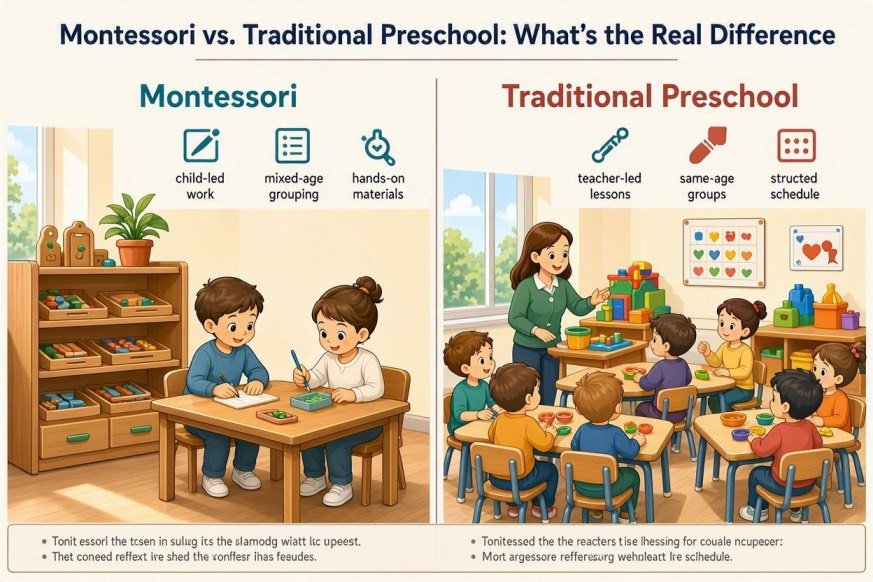
Quick answer: Montessori preschool emphasizes self-directed learning, mixed-age classrooms, and hands-on materials chosen by the child, while traditional preschool typically follows a more structured, teacher-led curriculum with same-age peer groups and a set daily schedule. The better fit depends on your child’s temperament and how they respond to structure versus independence. Before choosing a preschool for my son, I toured several Montessori and traditional options, and the differences that actually stood out during those real visits were quite different from what I’d expected based on reading about the two approaches beforehand.
The Montessori classrooms I visited had a noticeably different energy, quieter, with kids moving independently between different activity stations, choosing their own work rather than following a group-led lesson, which looked appealing in theory but made me genuinely uncertain whether my son, who tends to seek out adult direction and reassurance, would thrive in that much independent structure at his age.
The traditional preschools, by contrast, had a more familiar rhythm, group activities, a set schedule, more direct teacher guidance throughout the day, which felt more aligned with what I already knew about my son’s temperament, though I worried it might not build the same independence and self-direction the Montessori approach seemed to prioritize.
What Actually Mattered in Our Specific Decision
Watching how my son responded during a trial visit to each type of school turned out to matter more than any general comparison of the two philosophies, since he visibly sought out teacher reassurance and direction in the Montessori classroom in a way that suggested he wasn’t quite ready for that level of independent choice yet, while he engaged confidently and happily within the more structured traditional environment.
This observation mattered more to our actual decision than any broader argument about which philosophy is generally “better,” since the honest answer seems to be that neither approach is universally superior, they simply suit different children’s temperaments and developmental readiness differently.
What We’d Consider Differently for a Different Child
For a child who shows more natural independence and self-direction already, similar to how we’ve thought about choosing the right learning approach more broadly (see our related guide on how to choose the right learning approach for your child), Montessori’s self-directed structure might genuinely be a better fit than it was for my son at that particular age and stage.
We’ve also learned that individual schools within each broad category vary considerably, so visiting and observing your own specific child’s actual response during a trial visit matters far more than choosing based on the general philosophy alone, regardless of which approach initially sounds more appealing on paper.
| Factor | Montessori | Traditional Preschool |
| Structure | Self-directed, child-chosen activities | Teacher-led, structured schedule |
| Classroom age mix | Often mixed-age | Typically same-age peer groups |
| Best suited for | Kids showing natural independence | Kids who seek more direct guidance |
| Learning materials | Specific hands-on Montessori materials | Varied, often more group-activity based |
The Short Version
Neither Montessori nor traditional preschool is universally better — watching how your own specific child actually responds during a trial visit to each, rather than choosing based on general philosophy alone, revealed far more about which approach genuinely suited our son at his particular stage of development.
Related Reading on PlayAndGrow
how to choose the right learning approach for your child
best learning activities for 3-year-olds
homeschooling vs. traditional schooling: what actually matters
public school vs. private school: what really matters
how to help your child settle into a new school year
Questions Other Parents Ask Me
Is Montessori preschool better for independent kids?
Montessori’s self-directed structure often suits kids who already show natural independence and comfort with making their own choices, though readiness varies genuinely by individual child and age.
Does traditional preschool limit a child’s independence?
Not necessarily — a well-run traditional preschool can still build independence gradually within its more structured format, and some kids genuinely benefit from more direct guidance at younger ages before developing readiness for self-directed learning.
How can I decide between Montessori and traditional preschool for my child?
Observing how your specific child responds during a trial visit to each type of school tends to reveal more useful, concrete guidance than comparing the two philosophies in the abstract.