
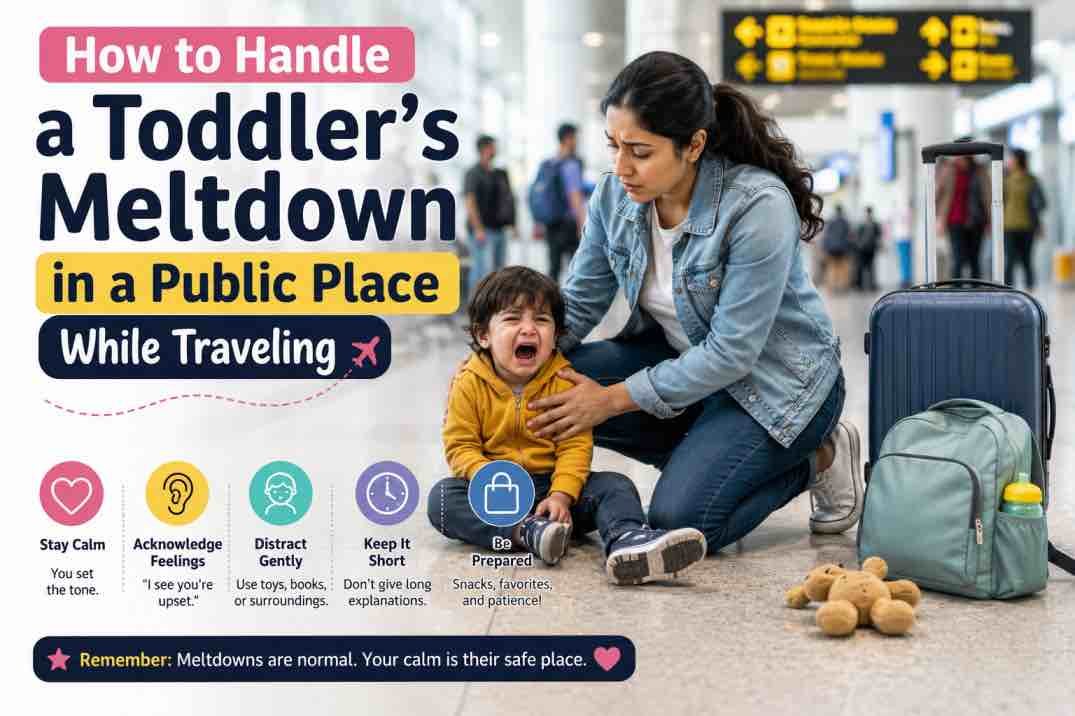
How to Handle a Toddler’s Meltdown in a Public Place While Traveling
A meltdown in an unfamiliar train station, surrounded by strangers and with none of our usual home coping tools available, felt genuinely harder to manage than the same kind of meltdown at home, even though the underlying toddler behavior wasn’t actually different in kind, just in setting.
Here’s how to handle a toddler’s meltdown in a public place while traveling, based on what’s actually helped us get through these moments without either giving in to something unreasonable or making the whole situation worse through our own rising stress.
| Quick AnswerTo handle a toddler’s meltdown in a public place while traveling, stay calm and avoid rushing to fix it out of embarrassment, find a quieter spot to move to if possible, acknowledge the feeling without giving in to an unreasonable demand, and remember that unfamiliar environments and disrupted routines genuinely make meltdowns more likely and harder for a toddler to regulate through, not a reflection of your parenting in that moment. |
Why Travel Makes Meltdowns More Likely and Harder to Manage
Disrupted routines, unfamiliar environments, and general travel fatigue all genuinely increase how often meltdowns happen and how intensely a toddler experiences them, since the coping mechanisms and predictability that normally help regulate big feelings are largely absent during travel. Recognizing this as a predictable consequence of travel itself, rather than a sign of unusually bad behavior, has helped me approach these moments with more patience than I might otherwise manage.
What Actually Helps in the Moment
Resist the Urge to Rush a Fix Out of Embarrassment
Public settings add a layer of self-consciousness that can push toward giving in quickly just to end the visible scene, but responding to the actual underlying need rather than the audience tends to lead to better outcomes even if it takes a bit longer.
Move to a Quieter Spot If Possible
Stepping away from the busiest, most stimulating part of a crowded space, even just to a slightly quieter corner, can genuinely help a toddler begin regulating, since sensory overload often compounds whatever originally triggered the meltdown.
Acknowledge the Feeling Without Meeting an Unreasonable Demand
Calmly naming what’s upsetting them, without necessarily giving in to whatever specific demand triggered the meltdown, helps a toddler feel heard while still maintaining a reasonable boundary.
Practical Tips
- Remind yourself that strangers witnessing a toddler meltdown are far less judgmental in reality than it feels in the anxious moment itself.
- Keep a couple of familiar comfort items easily accessible while traveling, since familiarity can help regulate big feelings in an unfamiliar setting.
- Build more buffer time and downtime into travel plans than you would at home, since travel fatigue genuinely increases meltdown frequency.
- Avoid making a major decision, like cutting a trip short, in the immediate heat of a single difficult moment, and revisit the choice once things have calmed down.
Key Takeaways
- Travel genuinely increases meltdown frequency and intensity due to disrupted routines and unfamiliar environments, not because of a parenting failure.
- Moving to a quieter space can help reduce the sensory overload that often compounds a public meltdown.
- Acknowledging a toddler’s feeling without necessarily meeting an unreasonable demand maintains both empathy and a reasonable boundary.
- Building extra rest and buffer time into travel plans can reduce how often meltdowns occur in the first place.
Conclusion
A public meltdown while traveling feels more stressful in the moment than the same behavior would at home, but the underlying approach that helps remains largely the same: staying calm, acknowledging the feeling, and holding reasonable boundaries without rushing to appease out of self-consciousness. Building in more rest and predictability where you can also reduces how often these moments happen in the first place.
Why do toddlers have more meltdowns while traveling?
Disrupted routines, unfamiliar environments, and general travel fatigue all reduce a toddler’s usual coping resources, making meltdowns genuinely more frequent and intense during travel than they might be in a familiar home setting.
Should I give in to a toddler’s demand during a public meltdown to make it stop?
Acknowledging the underlying feeling without necessarily meeting an unreasonable specific demand tends to lead to better outcomes over time than giving in purely to end a visible public scene quickly.
How can I prepare for potential meltdowns before a trip?
Packing familiar comfort items, building in more rest and downtime than usual, and mentally preparing for the likelihood of at least one difficult moment can all help you respond more calmly when a meltdown does happen.



One Comment