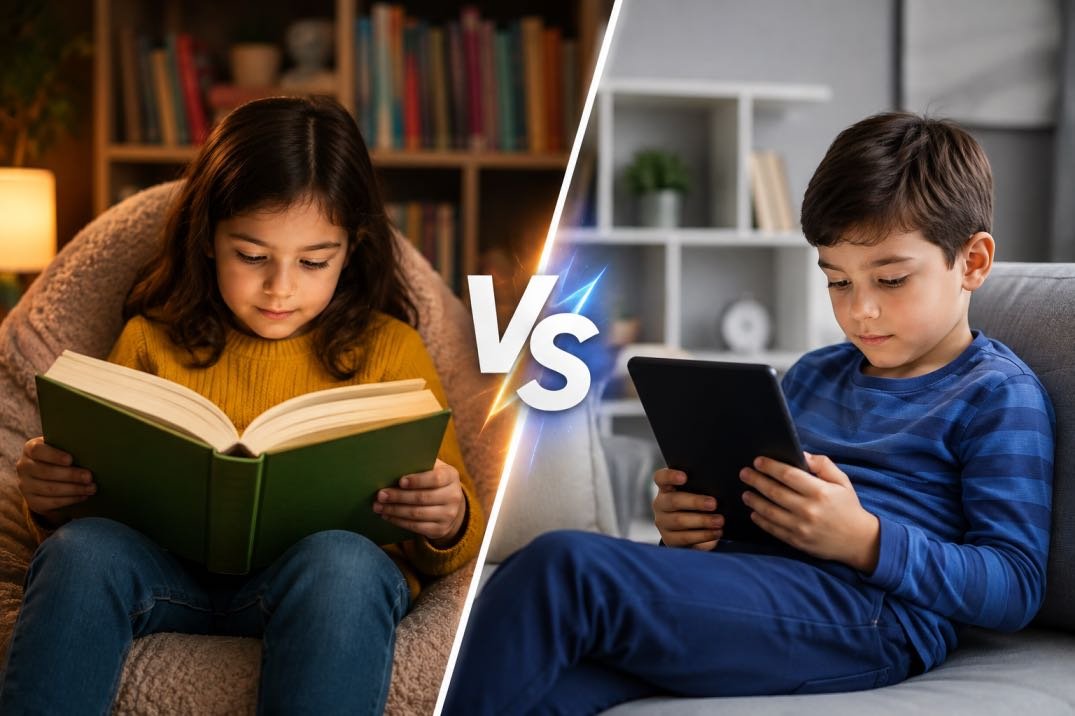
Physical Books vs. E-Books for Kids: What We’ve Actually Found
Quick answer: Physical books tend to support deeper focus and better retention for younger kids, especially at bedtime, while e-books offer real practical advantages for travel, accessing a wider library, and features like adjustable text size for developing readers. Using both, matched to the specific situation, has worked better for us than choosing one exclusively.
How We’ve Actually Split Their Use
1. Bedtime Reading: Physical Books Win — The tactile, screen-free nature of a physical book suits our bedtime wind-down routine far better, since a glowing screen right before sleep tends to work against the calm, sleepy mood we’re trying to build at that time of day.
2. Travel: E-Books Win — Carrying a whole library’s worth of books on a single device has been genuinely practical for long trips, avoiding the bulk and limited selection of packing physical books for every possible mood or reading level.
3. Building a Personal Library: Physical Books Win — There’s something about a child’s own growing shelf of physical books, ones they can revisit, lend to a friend, or simply see displayed, that an e-book collection doesn’t quite replicate in terms of a felt sense of ownership.
4. Trying a New Genre or Author: E-Books Win — The lower commitment and often lower cost of sampling an e-book has made us more willing to let a child try something outside their usual preferences, without the same investment as buying a physical copy sight unseen.
5. Beginning Readers: It Depends on the Child — Some kids benefit genuinely from an e-book’s adjustable text size and built-in read-aloud features, while others find a physical book’s simpler, distraction-free format easier to focus on, so this one really does come down to the individual child.
| Situation | Better Choice |
| Bedtime reading | Physical book |
| Travel | E-book |
| Building a personal library | Physical book |
| Trying a new genre | E-book |
| Beginning readers | Depends on the individual child |
Fast Tips
- Reserve screen-free physical books specifically for bedtime, to support a calmer wind-down routine.
- Use e-books strategically for travel, where carrying a whole library digitally offers real practical benefit.
- Let a child build a physical collection of genuine favorites, since ownership of physical books adds something e-books don’t quite replicate.
- Experiment with both formats for a beginning reader specifically, since individual preference varies more than a general rule can predict.
Quick FAQs
Are e-books worse for kids than physical books?
Not inherently — each format has genuine, situational advantages, and using both strategically, rather than avoiding one entirely, tends to work better than treating either as universally superior.
Why do physical books work better for bedtime specifically?
The screen-free, tactile nature of physical books suits a calm wind-down routine better than a glowing screen, which can work against the sleepy mood bedtime reading is meant to help build.
Do e-books help or hinder reading development?
This varies by individual child — some beginning readers benefit genuinely from e-book features like adjustable text size, while others find a physical book’s simpler format easier to focus on without distraction.