
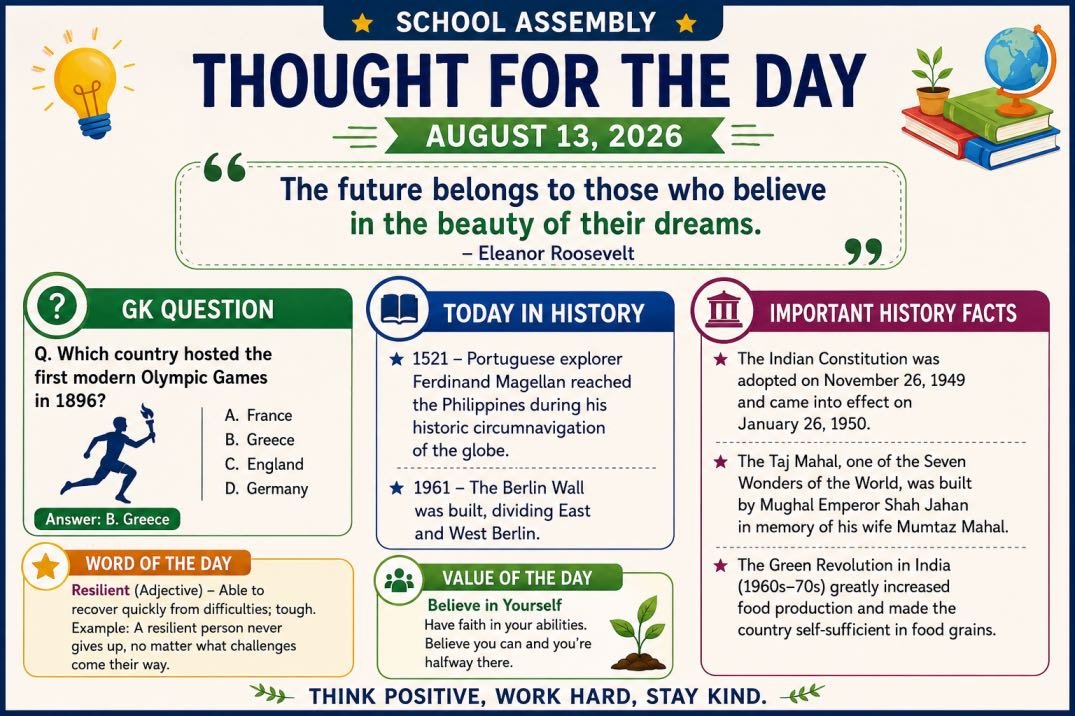
School Assembly Thought for the Day: August 13, 2026 (With GK Question and History Facts)
Thought for the Day (August 13, 2026): “Even an everyday material, looked at differently, can turn into something the whole world ends up using.”
Quick answer: This thought ties directly to a verified event on August 13 — English metallurgist Harry Brearley beginning production of stainless steel in Britain in 1913, an accidental discovery made while trying to solve a completely different problem, that went on to become one of the most widely used materials in the world. Below is everything needed for a complete assembly presentation.
As a parent, I’ve found that invention stories involving a genuine accident or unexpected discovery, rather than a carefully planned breakthrough, tend to fascinate kids more, since it shows that paying attention to something unexpected can matter just as much as a deliberate plan.
Why This Thought Fits August 13 Specifically
Harry Brearley was actually trying to develop a metal resistant to erosion for gun barrels when he noticed that one of his failed experimental samples hadn’t rusted after being left in his lab for weeks, an accidental observation that led him to begin producing what we now call stainless steel on this date in 1913.
This detail, that one of the most common materials in kitchens and buildings worldwide today came from a discarded, seemingly failed experiment, offers a genuinely memorable example of paying close attention even when something doesn’t go as originally planned.
How to Actually Deliver This at Assembly
Read the Thought for the Day slowly, then briefly explain Brearley’s accidental discovery, that he was originally trying to solve a completely different problem. Follow with the Word of the Day and its example sentence, then close with the GK Question.
Keeping the full presentation under two minutes tends to work best for a typical morning assembly slot.
Word of the Day
Corrosion (noun) — the gradual destruction of a material, typically metal, caused by chemical reactions with its environment, such as rusting. Example sentence: “Stainless steel resists corrosion far better than ordinary steel, which is why it doesn’t rust easily.”
GK Question of the Day
Question: Who is credited with beginning the production of stainless steel in 1913? Answer: Harry Brearley, an English metallurgist.
This Day in History — Verified Facts for August 13
1913: English metallurgist Harry Brearley began production of stainless steel in Britain, a discovery made while researching a corrosion-resistant metal for gun barrels.
1889: The coin-operated pay telephone was patented by William Gray of Hartford, Connecticut, an invention that would go on to shape public communication for much of the 20th century.
These two facts have been checked against standard historical references before inclusion here.
Parent Tip
Parent Tip: Invention stories involving an accidental discovery, rather than a carefully planned breakthrough, tend to genuinely fascinate kids, since they show that paying close attention to something unexpected can matter just as much as a deliberate plan.
Quick Comparison
| Element | Content for August 13, 2026 |
| Thought for the Day | “Even an everyday material, looked at differently, can turn into something the whole world ends up using.” |
| Word of the Day | Corrosion |
| GK Question | Who began producing stainless steel in 1913? — Harry Brearley |
| This Day in History | Stainless steel production begins (1913); coin-operated pay phone patented (1889) |
Practical Tips
- Highlight the accidental nature of Brearley’s discovery, which tends to make the invention story more memorable for kids.
- Add one simple GK question to turn a passive segment into brief audience participation.
- Keep the full presentation under two minutes; trim detail rather than rushing through everything.
- Verify any historical fact against a reliable source before including it in a live presentation.
Common Mistakes to Avoid
- Presenting an invention story as a purely deliberate, planned success when the more memorable detail is often the accidental discovery involved.
- Including unverified or invented historical facts rather than checking them against a reliable source.
- Skipping audience participation entirely, which tends to lose attention faster than a thought plus a brief question.
The Short Version
For August 13, 2026, a thought centered on paying attention to unexpected discoveries, tied to Harry Brearley’s accidental development of stainless steel in 1913, gives a short assembly presentation a genuinely memorable, kid-friendly invention story, with a simple GK question turning it into a moment of real audience participation.
Related Reading on PlayAndGrow
school assembly thought for the day, August 12, 2026
school assembly thought for the day, August 11, 2026
easy science experiments to do at home
our Independence Day wishes and messages for family and kids
FAQs
What is a good thought for the day for August 13, 2026?
“Even an everyday material, looked at differently, can turn into something the whole world ends up using” works well, tying naturally to the beginning of stainless steel production on this date in 1913.
What historical event happened on August 13?
Harry Brearley began producing stainless steel in Britain on August 13, 1913, and the coin-operated pay telephone was patented by William Gray on this date in 1889.
Was the invention of stainless steel planned or accidental?
It was largely accidental — Harry Brearley was originally researching a corrosion-resistant metal for gun barrels when he noticed one of his experimental samples hadn’t rusted, leading to the discovery of stainless steel.
What is a good GK question for a school assembly on this date?
“Who began producing stainless steel in 1913?” works well, with the answer, Harry Brearley, tying directly to the day’s history fact.





One Comment
Comments are closed.