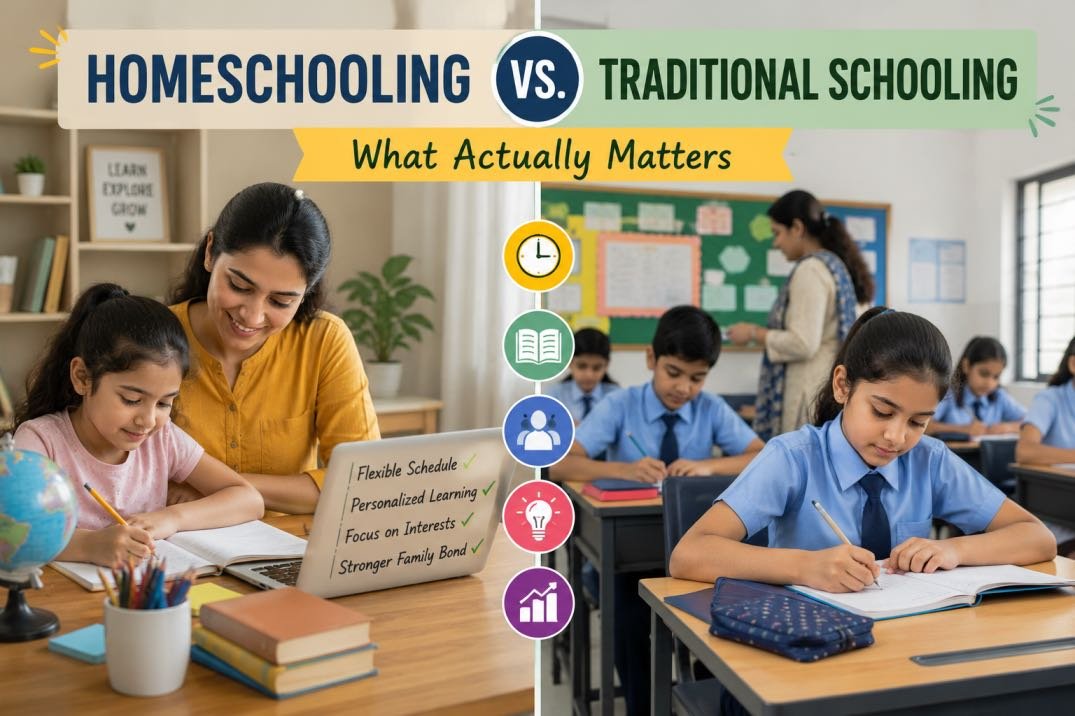
Homeschooling vs. Traditional Schooling: What Actually Matters
Quick answer: Homeschooling offers flexibility, individualized pacing, and more control over content, while traditional schooling offers structured socialization, a broader range of activities, and a more predictable routine for both child and parent. Neither is universally better, and the right choice depends on your specific child, family capacity, and local school quality. We spent nearly a full year genuinely weighing homeschooling for our daughter, driven mostly by frustration with a rigid pacing that didn’t suit her, before ultimately choosing to stay in traditional school with some adjustments instead.
That decision process taught us more about what actually mattered in the comparison than any general pros-and-cons list had, since a lot of the genuine trade-offs only became clear once we honestly assessed our own family’s specific capacity and needs.
What I Tried First (and Why It Didn’t Work)
We initially approached the decision almost entirely around academic pacing, since our daughter was clearly ready to move faster than her classroom’s set pace allowed, without weighing the social and logistical sides of the comparison with equal seriousness.
This narrow framing made homeschooling look like the obvious answer for a while, until we actually sat down and honestly assessed whether we had the genuine time, patience, and teaching capacity to sustain it well, which was a considerably harder and more honest conversation than the academic pacing question alone.
What Traditional School Still Offered That We Undervalued
The daily, built-in social structure of traditional school, the friendships, the group activities, the simple routine of being around other kids all day, turned out to matter more to our daughter than either of us had fully appreciated during the months we spent seriously considering homeschooling. This is closely tied to how important it is to help kids make friends in a new environment (see our related guide on how to help your child make friends in a new neighborhood), since social connection built gradually through consistent daily contact is genuinely hard to replicate outside a school setting.
We also underestimated how much the school’s structured extracurricular access, sports, arts, group projects, contributed to her overall development beyond pure academics, resources that would have required considerably more independent effort and cost to replicate at home.
What Ultimately Tipped the Decision
Being honest about our own actual daily capacity, not an idealized version of how much time and patience we imagined we’d have for teaching, made the biggest difference in the final decision. Homeschooling well demands genuine, sustained daily effort, and we recognized that neither of us could realistically sustain that alongside our existing work commitments without something else suffering.
We ultimately addressed the original academic pacing frustration through a conversation with her teacher about supplemental, faster-paced material at home, which resolved the actual underlying problem without needing the much bigger structural change homeschooling would have required.
| Factor | Homeschooling | Traditional Schooling |
| Pacing flexibility | High, fully individualized | Limited, set by classroom pace |
| Social structure | Requires deliberate effort to build | Built-in daily social contact |
| Parent time/effort required | Very high, sustained daily commitment | Lower, delegated to school structure |
| Extracurricular access | Requires independent arrangement | Often built into the school day |
If you only remember one thing:
Before choosing between homeschooling and traditional schooling, honestly assess your family’s actual daily capacity for sustained teaching effort, not an idealized version of it — this single honest conversation revealed more about our real decision than the academic pros-and-cons list ever did.
Related Reading on PlayAndGrow
how to help your child settle into a new school year
how to build a good relationship with your child’s teacher
how to help your child make friends in a new neighborhood
how to help your child set realistic weekly goals for school
how to choose the right learning approach for your child
how to encourage kids to try new extracurricular activities
Quick Answers
Is homeschooling better for academically advanced kids?
Homeschooling can offer more individualized pacing, but many academically advanced kids also do well in traditional school with supplemental material or advanced grouping, so it’s worth exploring adjustments within traditional school first before assuming homeschooling is the only solution.
What does traditional schooling offer that’s hard to replicate at home?
Built-in daily social structure and access to extracurricular activities like sports and group projects are often harder and more resource-intensive to replicate independently through homeschooling.
How much time does homeschooling genuinely require from a parent?
This varies by approach and child, but homeschooling well typically demands substantial, sustained daily time and effort, which is worth honestly assessing against your family’s actual capacity before committing.
Can academic pacing frustrations be solved without switching to homeschooling?
Often yes — a conversation with a child’s teacher about supplemental or advanced material can resolve pacing frustrations without requiring the larger structural change homeschooling involves.




One Comment
Comments are closed.