
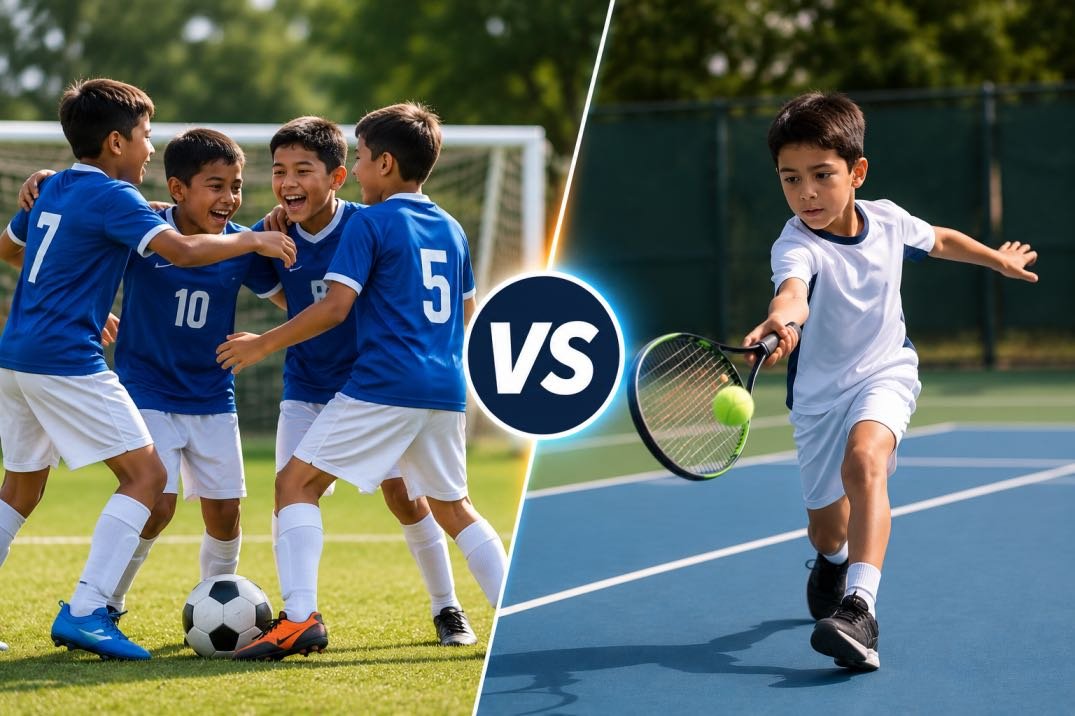
Group Sports vs. Individual Sports for Kids: Which Actually Fits
My daughter and son responded to the same team sport completely differently, which taught me that the group versus individual sports decision has less to do with athletic ability and more to do with each child’s actual social temperament.
Here’s group sports vs. individual sports for kids, based on what’s actually mattered in how our two very different kids have responded to each option.
| Quick Answer: Group sports build teamwork, social connection, and shared accountability, while individual sports build self-motivation, personal goal-setting, and a sense of accomplishment not dependent on teammates. The better fit depends more on a child’s temperament, specifically whether they’re energized or drained by group dynamics, than on athletic talent alone. |
Why Temperament Matters More Than Talent
A child’s actual energy and comfort level around group dynamics, whether being part of a team feels energizing or draining, tends to predict enjoyment and sustained engagement far more reliably than raw athletic ability, which surprised me since I’d initially assumed skill level would be the deciding factor.
What Each Option Genuinely Builds
Group Sports
Teamwork, shared accountability to teammates, and social connection built through consistent group activity are genuine strengths of team sports, particularly for kids who find group dynamics energizing rather than draining.
Individual Sports
Self-motivation, personal goal-setting, and a sense of accomplishment not dependent on others’ performance are genuine strengths of individual sports, particularly for kids who prefer more control over their own pace and progress.
Practical Tips
- Observe how your child responds to group activities generally, not just their raw athletic ability, when choosing between group and individual sports.
- Try both formats if genuinely uncertain, since actual experience often reveals preference more clearly than prediction alone.
- Don’t assume a child who struggles socially will automatically prefer individual sports, since some kids benefit from the built-in social structure a team provides.
- Revisit the choice periodically, since a child’s preference can genuinely shift as they grow and their social temperament develops.
Key Takeaways
- A child’s social temperament, not just athletic ability, tends to predict enjoyment and engagement in group versus individual sports.
- Group sports build teamwork and social connection, while individual sports build self-motivation and personal goal-setting.
- Observing how a child responds to group dynamics generally offers useful guidance before choosing a specific sport.
- Preferences can genuinely shift over time, making it worth revisiting the choice periodically.
Conclusion
Choosing between group and individual sports works best when guided by your specific child’s social temperament, not assumptions based on athletic talent alone. Pay attention to whether group dynamics genuinely energize or drain your child, and let that observation guide the decision.
Related Reading on PlayAndGrow
confidence building activities for kids
how to encourage kids to try new extracurricular activities
how to help your child make friends in a new neighborhood
best team-building games for a kids’ birthday party
FAQs
How do I know if my child would prefer group or individual sports?
Observing how your child generally responds to group activities and dynamics, whether energized or drained by them, tends to offer more useful guidance than athletic ability alone.
Can a child who struggles socially still benefit from group sports?
Yes, some kids who struggle socially in unstructured settings actually benefit from a team sport’s built-in structure and shared purpose, so it’s worth not assuming individual sports are automatically the better fit.
Should kids try both group and individual sports before choosing?
If genuinely uncertain, trying both formats can reveal a clearer preference through actual experience than prediction alone, and many kids benefit from exposure to both at different points.