
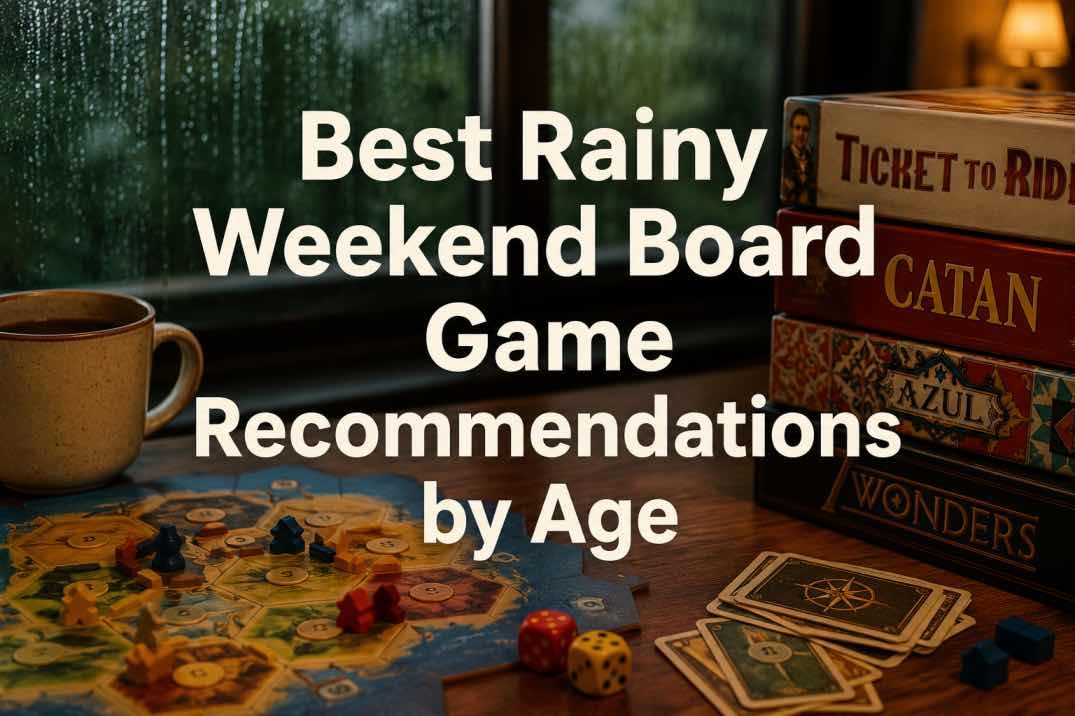
Best Rainy Weekend Board Game Recommendations by Age
Our board game shelf grew fairly haphazardly for a couple of years, mostly gifts and impulse purchases that seemed like good ideas at the time, and a genuinely surprising number of them sat almost entirely untouched because they didn’t actually match either of my kids’ ages when we bought them, or their interests had already moved past that stage by the time we finally tried playing.
It wasn’t until I started paying closer attention to how age-specific board game recommendations actually work, rather than assuming a game marked for a broad ‘kids’ age range would suit both my five-year-old and my eight-year-old equally, that our rainy weekend game rotation actually started getting regular, enthusiastic use rather than a shrug and a request for something else.
The difference once we matched games more carefully to actual current age and skill level was substantial enough that I now think about board game purchases far more deliberately, checking not just the recommended age range on the box but genuinely considering whether the specific mechanics and complexity actually suit where each child is right now.
Games That Have Worked Well for Younger Kids (Ages 4-6)
Simple games with minimal rules and a strong element of luck rather than strategy tend to work best at this age, since younger kids often find purely strategic games frustrating before their planning and patience skills have developed enough to genuinely engage with real strategic decision-making. Games involving basic color or shape matching, simple races around a board determined by a spinner or die, and cooperative games where everyone works together toward one shared goal rather than competing against each other have all held up well.
Cooperative games in particular deserve more attention than they often get for this age group, since removing the pressure of losing to a sibling or friend, and instead framing the game as everyone winning or losing together, tends to reduce the meltdowns that purely competitive games can trigger before a child has developed much tolerance for losing gracefully.
Games That Have Worked Well for Older Kids (Ages 7-10)
By this age, games involving genuine strategic decision-making, some hidden information, and enough complexity to require real thought rather than pure luck tend to hold attention far better than the simpler games that suited earlier ages. We’ve had particular success with games involving resource management, where players need to plan several moves ahead, and simple deduction games, where working out hidden information based on clues becomes its own satisfying puzzle.
Games with a reasonable playtime, somewhere between twenty and forty-five minutes, also matter more at this age than it might seem, since a game that drags on too long tends to lose even an older child’s genuine engagement by the end, while something too short doesn’t offer enough depth to feel satisfying.
| Age Range | Game Type That Works Well |
| 4-6 years | Simple luck-based games, cooperative games, basic matching |
| 7-8 years | Light strategy, simple deduction, moderate playtime |
| 9-10 years | Deeper strategy, resource management, longer playtime tolerance |
The Short Version
Matching a board game’s actual complexity and mechanics to a child’s genuine current age and skill level, rather than relying on a broad recommended age range alone, makes the real difference between a game that gets regular, enthusiastic use and one that sits untouched on a shelf. Cooperative games deserve particular attention for younger kids, while strategy and moderate playtime matter more as kids get older.
What board games are good for a 5-year-old?
Simple games with minimal rules, a strong element of luck over strategy, and cooperative options where everyone works together toward one shared goal tend to work best for kids around this age.
Are cooperative board games good for young kids?
Yes, cooperative games remove the pressure of losing to a sibling or friend, framing the outcome as shared, which tends to reduce meltdowns before a child has developed much tolerance for losing gracefully in a competitive format.
What should I look for in a board game for an 8-year-old?
Games involving some genuine strategic decision-making and moderate complexity, with a playtime somewhere between twenty and forty-five minutes, tend to hold an 8-year-old’s attention better than either overly simple or excessively long games.




2 Comments