
Friendship Day Games for the Classroom
Quick answer: The best Friendship Day classroom games mix kids who don’t usually interact, involve quick, low-pressure participation, and end with everyone feeling included, not just one clear winner. Here are the ones that have actually worked, whether you’re a teacher or a parent organizing something similar at home.
Games That Actually Build Connection
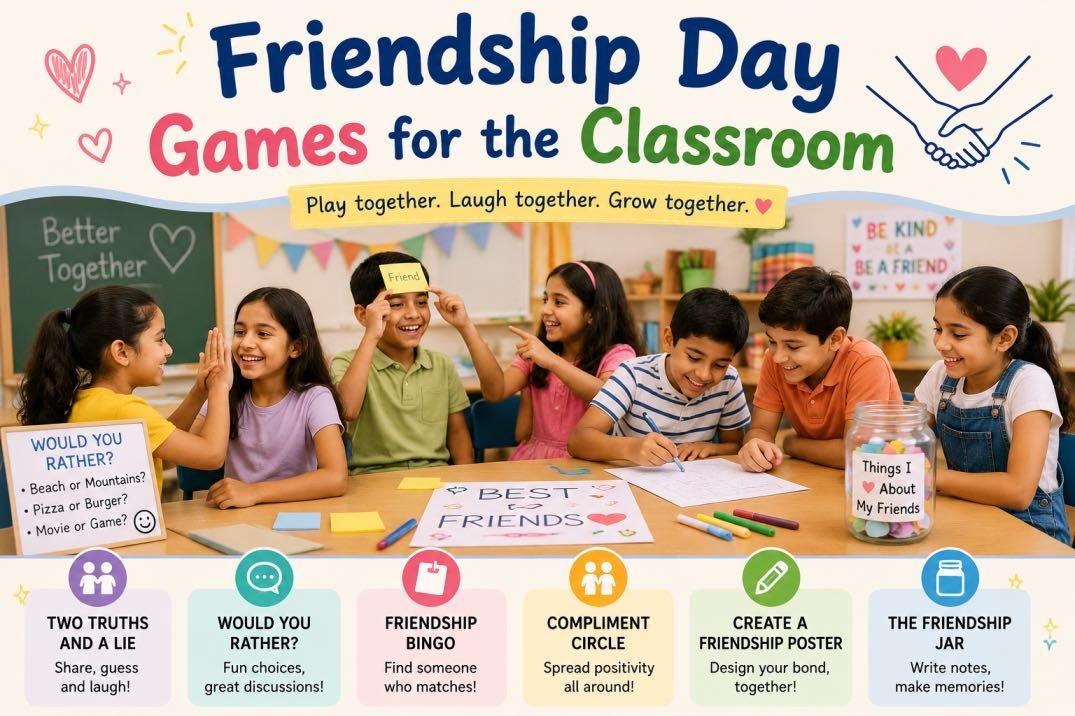
1. Find Your Match — Hand out cards with matching pairs, a picture and its matching word, or two halves of a phrase, and have kids find their partner. It’s a simple, low-pressure way to pair up kids who might not usually sit together, and the mixing itself is really the point.
2. Compliment Circle — In a circle, each child says one genuine, kind thing about the person next to them. Keeping it structured (one specific compliment, not open-ended) prevents awkward silences and keeps the activity moving while still feeling meaningful.
3. Friendship Bingo — A bingo card filled with statements like ‘has a pet’ or ‘likes the same book as you,’ where kids move around finding classmates who match each square. It naturally encourages conversation and discovering small things in common.
4. Team Trust Walk — In pairs, one child is gently guided by a partner giving simple verbal directions, building a small, safe moment of trust and cooperation between kids who take turns in each role.
5. Group Story Building — Sitting in a circle, each child adds one sentence to a story the group builds together, which requires genuine listening and turns collaborative silliness into a shared, memorable activity.
| Game | Group Size | Best For |
| Find Your Match | Any size | Mixing up usual friend groups |
| Compliment Circle | Small to medium groups | Building warmth quickly |
| Friendship Bingo | Medium to large groups | Encouraging conversation |
| Team Trust Walk | Pairs | A small moment of real trust |
Fast Tips
- Choose games that naturally mix up existing friend groups rather than reinforcing who already sits together.
- Keep instructions simple enough that a game starts within a minute or two of explaining it.
- End on a positive, inclusive note rather than a game with one clear, singled-out winner.
- Adjust group sizes based on your specific classroom or gathering, since most of these scale easily up or down.
Also read:
Best Friendship Stories with Moral for Kids to Inspire Kindness and Trust
Friendship Day Essay for Students (100, 200, and 500 Words)
Friendship Day 2026 Date in India (and Why There Are Two Different Dates)
Why Do We Celebrate Friendship Day? A Simple Explanation for Kids
Friendship Day Celebration Ideas at School That Kids Will Always Remember
Friendship Day Quotes and Speech for Kids: Inspiring Words for School & Celebrations
Friendship Day Craft Ideas: DIY Friendship Bands for Kids
What is a good Friendship Day game for a classroom?
Find Your Match and Friendship Bingo both work well for mixing up existing friend groups and encouraging kids to interact with classmates they might not usually talk to.
How can Friendship Day games avoid leaving anyone feeling left out?
Choosing games without one single, clearly declared winner, and structuring activities so everyone participates equally, like a compliment circle, helps keep the mood inclusive rather than competitive.
Are these games suitable for use at home, not just school?
Yes, most of these work well for a smaller group of friends gathering at home too, adjusted slightly for the smaller group size.




One Comment