
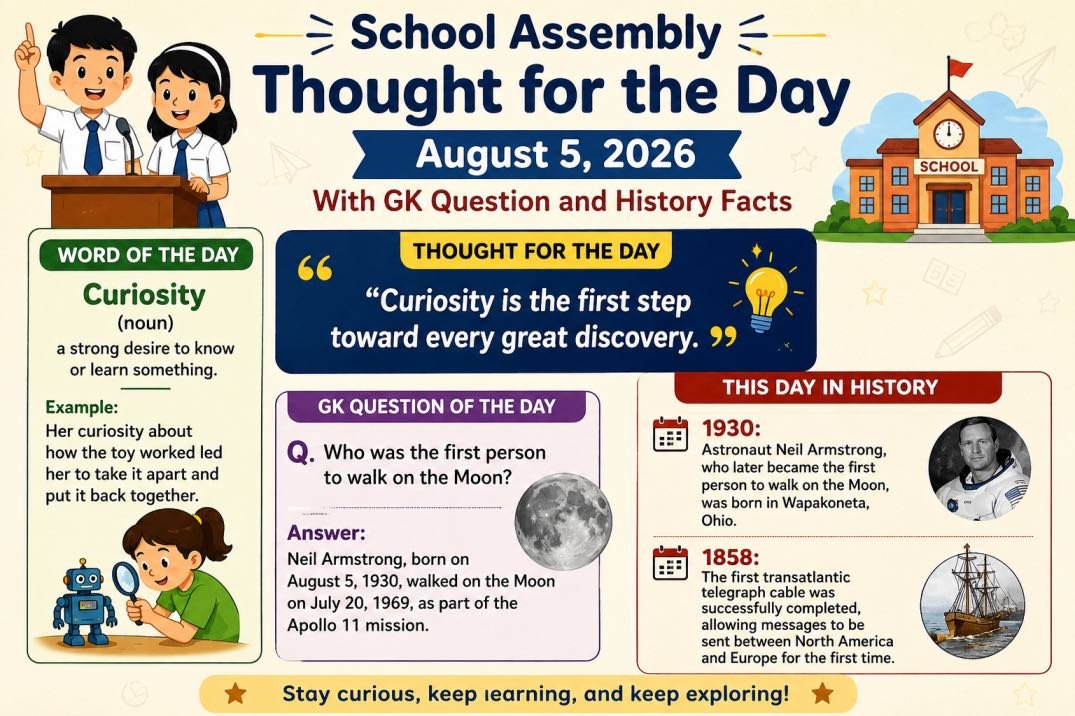
School Assembly Thought for the Day: August 5, 2026 (With GK Question and History Facts)
Quick answer: This thought ties directly to two verified events on August 5 — astronaut Neil Armstrong’s birth in 1930, and the completion of the first successful transatlantic telegraph cable in 1858. Both were driven by the same thing: genuine curiosity about what lay beyond the known. Below is everything needed for a complete assembly presentation — the thought, a word of the day, a GK question, and verified history facts.
As a parent, I’ve found that kids tend to remember a Thought of the Day better when it’s genuinely tied to a real event, not a generic inspirational line with no real connection to the day. This is especially true for a date with no attached festival or national occasion, where the better approach is building the day’s theme around whatever verified historical facts actually happened on that date, so the thought has something concrete behind it.
Why This Thought Fits August 5 Specifically
Neil Armstrong, born on this exact date in 1930, went on to become the first person to walk on the Moon, an achievement rooted directly in curiosity about what existed beyond Earth. The first transatlantic telegraph cable, completed on the same date in 1858, came from the same underlying drive: wanting to connect two continents that had never been able to communicate instantly before. Both events genuinely happened on August 5, which is what makes the thought fit the day rather than feeling like a generic quote attached arbitrarily.
How to Actually Deliver This at Assembly
Read the Thought for the Day slowly, then pause for a second before explaining the connection to Armstrong and the telegraph cable, rather than rushing through all the information at once. Follow with the Word of the Day and its example sentence, then close with the GK Question, inviting a quick response from the audience rather than simply stating the answer.
Keeping the full presentation under two minutes tends to work best for a typical morning assembly slot, so trim any section that feels like it’s running long rather than including every possible detail.
Word of the Day
Curiosity (noun) — a strong desire to know or learn something. Example sentence: “Her curiosity about how the toy worked led her to take it apart and put it back together.”
GK Question of the Day
Question: Who was the first person to walk on the Moon? Answer: Neil Armstrong, born on August 5, 1930, walked on the Moon on July 20, 1969, as part of the Apollo 11 mission.
This Day in History — Verified Facts for August 5
1930: Astronaut Neil Armstrong, who later became the first person to walk on the Moon, was born in Wapakoneta, Ohio.
1858: The first transatlantic telegraph cable was successfully completed, allowing messages to be sent between North America and Europe for the first time in history.
These two facts have been checked against standard historical references before inclusion here, since an assembly presentation repeating an inaccurate date or event undermines the whole point of a ‘this day in history’ segment.
Parent Tip
Parent Tip: On a date without a specific festival or occasion, build the day’s thought around a broader theme, like curiosity or perseverance, tied loosely to whatever historical facts actually happened that day, rather than forcing an artificial connection. Adding one GK question turns a passive listening moment into brief audience participation, which tends to hold attention better than the thought and history facts alone.
Quick Comparison
| Element | Content for August 5, 2026 |
| Thought for the Day | “Curiosity is the first step toward every great discovery.” |
| Word of the Day | Curiosity |
| GK Question | Who was the first person to walk on the Moon? — Neil Armstrong |
| This Day in History | Neil Armstrong born (1930); first transatlantic telegraph cable completed (1858) |
| Theme | Curiosity and exploration |
Practical Tips
- On a date without a specific occasion, build the thought around a broader theme tied to the day’s actual historical facts.
- Add one simple GK question to turn a passive segment into brief audience participation.
- Keep the full presentation under two minutes; trim detail rather than rushing through everything.
- Verify any historical fact against a reliable source before including it in a live presentation.
Common Mistakes to Avoid
- Forcing an artificial theme onto a date that doesn’t genuinely connect to any real occasion or historical fact.
- Including unverified or invented historical facts rather than checking them against a reliable source.
- Skipping audience participation entirely, which tends to lose attention faster than a thought plus a brief question.
The Short Version
For August 5, 2026, a thought centered on curiosity, tied to Neil Armstrong’s birth and the completion of the first transatlantic telegraph cable, both genuinely on this date, gives a short assembly presentation real, verified substance, and adding a simple GK question turns it into a moment of actual audience participation rather than passive listening.
Related Reading on PlayAndGrow
our Guru Purnima essay for students, another school-prep resource
our full list of easy arts and crafts ideas for kids at home
best activities for 9-year-olds at home
Guru Purnima teacher appreciation activities for kids
FAQs
What is a good thought for the day for August 5, 2026?
“Curiosity is the first step toward every great discovery” works well, tying naturally to Neil Armstrong’s birth and the first transatlantic telegraph cable, both genuine historical events on this date.
What historical event happened on August 5?
Astronaut Neil Armstrong was born on August 5, 1930, and the first transatlantic telegraph cable was completed on August 5, 1858.
What is a good GK question for a school assembly on this date?
“Who was the first person to walk on the Moon?” works well here, with the answer, Neil Armstrong, tying directly back to his birthday falling on this same date.
How do I build an assembly thought for a date with no specific occasion?
Building the day’s reflection around a broader theme, like curiosity or perseverance, tied loosely to the date’s actual verified historical facts, works well when no specific festival or occasion falls on that day.
How long should a school assembly thought-for-the-day segment last?
Keeping the full presentation, thought, word of the day, GK question, and history fact, under two minutes tends to suit a typical morning assembly slot better than including every possible detail.






One Comment
Comments are closed.