Bribing vs. Rewarding Kids: Is There a Real Difference?
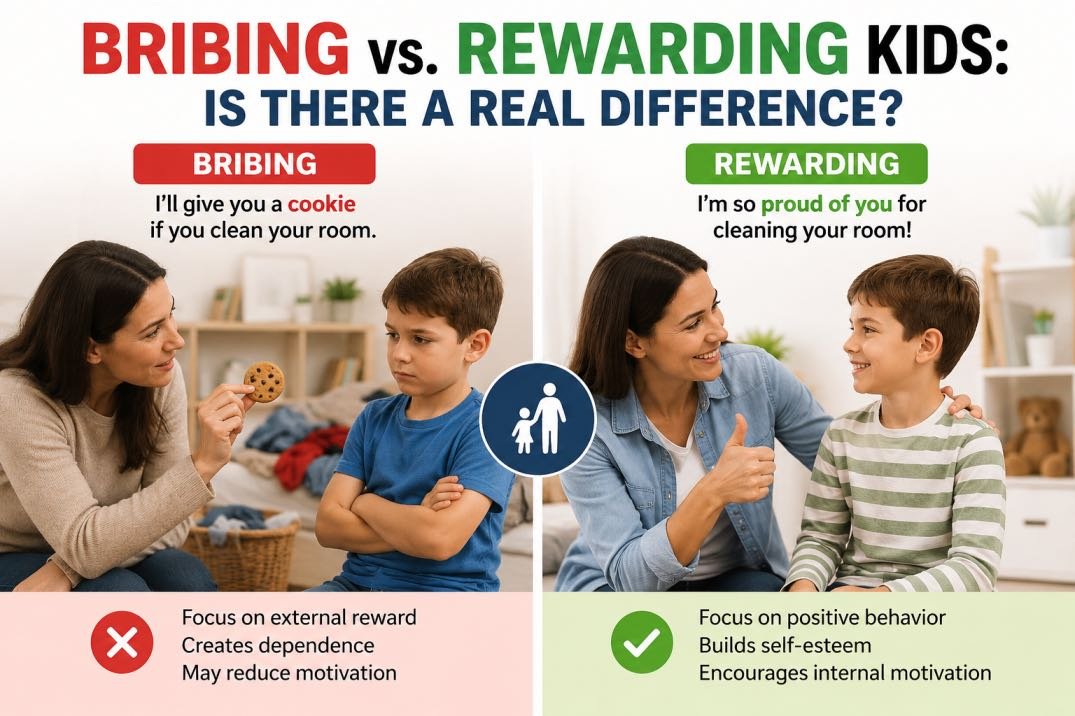
Quick answer: The key difference is timing and intent — a bribe is offered in the moment to stop an ongoing behavior (“stop crying and I’ll give you candy”), while a reward is planned in advance for a specific, positive behavior (“if you get ready on time all week, we’ll do something fun on Saturday”). Bribes tend to reinforce the very behavior you’re trying to stop, while planned rewards reinforce the behavior you actually want. I used to use the two terms interchangeably, offering my son a treat mid-tantrum to get him to calm down, and calling it a reward when really it was a fairly clear bribe.
It took noticing a pattern, that these mid-meltdown offers seemed to actually increase how often tantrums happened, since he’d learned that big emotional displays reliably produced a treat, before I looked more carefully at the actual distinction between bribing and legitimate rewarding.
What I Tried First (and Why It Didn’t Work)
I offered treats or privileges in the moment, mid-tantrum or mid-refusal, specifically to get an immediate behavior change, without any advance planning or clear connection to a positive behavior I actually wanted to encourage long-term.
This worked in the short term, ending the immediate meltdown, but I started noticing tantrums happening more frequently over time, which in hindsight makes sense, since I was effectively teaching him that a big enough emotional display reliably produced a treat.
Understanding the Actual Distinction
A genuine reward is planned in advance, tied to a specific positive behavior, and communicated clearly before the behavior happens, similar in spirit to how a well-designed reward chart works (see our related guide on reward chart printable ideas for kids) — the child knows the terms upfront, rather than the reward being offered reactively in response to a problem behavior already happening.
A bribe, by contrast, is reactive, offered in the moment specifically to stop an undesirable behavior that’s already occurring, which inadvertently teaches a child that the undesirable behavior itself is an effective way to get something they want.
How This Distinction Changed Our Approach
We stopped offering anything mid-tantrum entirely, since any offer at that point, however well-intentioned, functions as a bribe regardless of what we called it, and instead moved any positive incentive to a pre-planned, advance conversation about a specific behavior we wanted to encourage.
This shift took real discipline on my part, since it’s genuinely tempting to offer something in the heat of a public meltdown just to make it stop quickly, but sticking to planned rewards rather than reactive bribes has noticeably reduced how often tantrums happen in the first place, since the emotional display no longer reliably produces anything.
| Bribe | Legitimate Reward |
| Offered reactively, mid-behavior | Planned in advance |
| Responds to a negative behavior already happening | Tied to a specific positive behavior |
| Teaches that the negative behavior gets results | Reinforces the desired behavior |
| Communicated in the heat of the moment | Communicated clearly before the behavior |
If you only remember one thing:
The real distinction between a bribe and a legitimate reward is timing — a reward planned in advance for a specific positive behavior reinforces what you actually want, while anything offered reactively to stop an undesirable behavior already happening functions as a bribe, regardless of what you call it.
Related Reading on PlayAndGrow
| Read Next | Link |
| reward chart printable ideas for kids | /reward-chart-printable-ideas-for-kids |
| strict parenting vs. gentle parenting: what actually worked for us | /strict-parenting-vs-gentle-parenting-what-actually-worked-for-us |
| timeout vs. time-in: which discipline method actually works | /timeout-vs-time-in-which-discipline-method-actually-works |
| chore chart by age | /chore-chart-by-age |
| how to encourage kids to help with household chores during summer break | /how-to-encourage-kids-to-help-with-household-chores-during-summer-break |
Quick Answers
Is it ever okay to offer a bribe to stop a tantrum?
Occasional use may stop an immediate crisis, but consistently offering something reactively during a tantrum tends to teach a child that the tantrum itself is an effective way to get what they want, making it worth avoiding as a regular strategy.
How can I set up a legitimate reward system?
Planning the reward in advance, tying it to a specific, clearly communicated positive behavior, rather than offering something reactively in response to a problem already happening, is the key distinction that makes a reward system genuinely effective.
Does using rewards spoil a child or create unhealthy expectations?
Thoughtfully planned, specific rewards tied to genuine effort tend to work differently than constant, vague rewarding, so the structure and intentionality behind the system matters more than whether rewards are used at all.