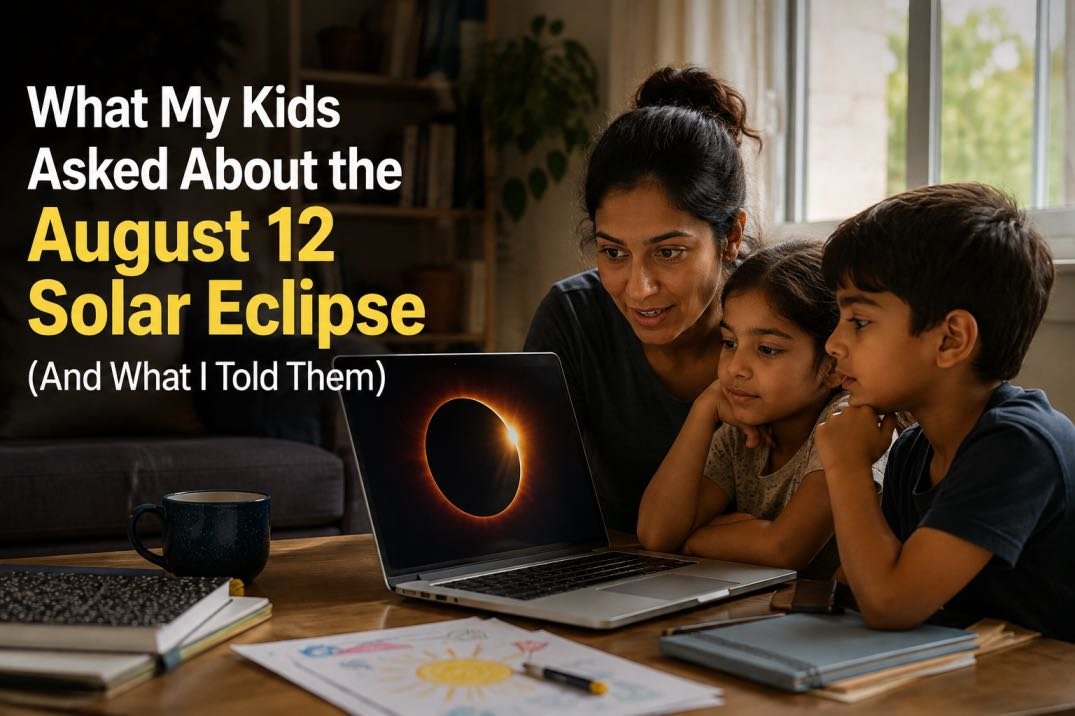
What My Kids Asked About the August 12 Solar Eclipse (And What I Told Them)
Quick answer: A total solar eclipse will occur on August 12, 2026, but it will NOT be visible from India, since the path of totality passes over the Arctic, Greenland, Iceland, and northern Spain. My kids heard about it from a classmate and immediately had a string of questions, starting with whether we’d need to stay indoors that day, which told me they’d absorbed some version of traditional eclipse beliefs without really understanding what an eclipse actually is.
My daughter’s first question was surprisingly practical: would school be cancelled. My son’s was less practical and more dramatic: would it suddenly go dark outside. Neither question, it turned out, actually applied to us, since the eclipse simply won’t be visible from where we live at all, but working through why took a genuinely interesting conversation.
I ended up explaining both the actual astronomy and the traditional beliefs they’d half-heard from their grandmother, since dismissing one to explain the other felt like the wrong approach for a conversation that was clearly about more than just facts to them.
What I Actually Told Them About Why We Won’t See It
I explained that a solar eclipse happens when the Moon passes directly between the Sun and the Earth, blocking the Sun’s light, but that this only creates a visible eclipse in a narrow path on Earth’s surface, wherever the Moon’s shadow actually falls. This time, that path falls over the Arctic, Greenland, Iceland, and a small part of northern Spain and Portugal, nowhere close to India.
This genuinely surprised my son, who’d assumed an eclipse was something the whole world sees at once, and working through why that’s not the case, using a simple demonstration rather than just telling him, made the explanation land considerably better than words alone would have.
A Simple Way to Show Them How It Works
We used a torch and a small ball to demonstrate, the torch as the Sun, the ball as the Moon, and my son’s head as the Earth, moving the ball between the torch and his face to show how a shadow only falls on part of a surface, not everywhere at once. This simple setup made the “why isn’t it visible everywhere” question click in a way that just explaining it verbally hadn’t.
My daughter then asked to try it herself, moving the ball at different angles to see how the shadow’s position changed, which turned a five-minute explanation into a genuinely engaged fifteen minutes of her testing the idea out on her own.
Addressing the Traditional Beliefs Honestly
Rather than dismissing what their grandmother had told them about eclipses, staying indoors, not eating during the eclipse window, I explained that these are genuine, long-held traditional beliefs in many families, worth respecting even if they’re not something we personally follow strictly, and that scientifically, eclipses are predictable, natural events that don’t have a direct physical effect on people.
I told them plainly that since this particular eclipse isn’t even visible from India, none of those traditional precautions would practically apply to us this time regardless, which seemed to satisfy their curiosity without requiring me to take a firm stance one way or the other on the broader tradition.
Parent Tip
Parent Tip: A simple torch-and-ball demonstration explains eclipse visibility far better than words alone. Let an older kid hold and move the “moon” themselves, actually testing the idea tends to make it click faster than watching a parent demonstrate it.
Quick Comparison
| Question | What I Told Them |
| Will it get dark outside for us? | No, since the eclipse isn’t visible from India at all |
| Why isn’t it visible everywhere? | A shadow only falls on part of the Earth’s surface |
| Is it true we shouldn’t eat during an eclipse? | That’s a traditional belief some families follow; it isn’t a scientific requirement |
| When is the next one we might actually see? | Worth checking closer to the date, since visibility changes each time |
Practical Tips
- Use a simple torch-and-ball demonstration to show why an eclipse is only visible from a specific part of Earth.
- Address traditional beliefs respectfully rather than dismissing them outright, even if your family doesn’t follow them strictly.
- Check the specific visibility path before assuming a headline-making eclipse will actually be visible from your location.
- Let an older child handle the demonstration themselves, testing an idea tends to build understanding faster than watching it explained.
Common Mistakes to Avoid
- Assuming a major eclipse will automatically be visible everywhere, including from India, without checking the specific path.
- Dismissing a child’s traditional beliefs about eclipses outright, rather than explaining both the science and the tradition honestly.
- Explaining eclipse mechanics purely verbally without a simple, hands-on demonstration to make the concept concrete.
The Short Version
The August 12, 2026 solar eclipse won’t be visible from India at all, since its path passes over the Arctic, Greenland, Iceland, and northern Spain, and explaining this to my kids with a simple torch-and-ball demonstration, alongside honestly addressing the traditional beliefs they’d heard from their grandmother, made for a genuinely engaged conversation rather than a dry astronomy lesson.
Related Reading on PlayAndGrow
Why do we celebrate Guru Purnima, another tradition explained honestly/
Bhagavad Gita lessons for kids
Why do we touch elders’ feet, another tradition explained honestly
Shiva stories kids love
FAQs
Will the August 12, 2026 solar eclipse be visible in India?
No, the path of totality passes over the Arctic, Greenland, Iceland, and northern Spain and Portugal, nowhere near India, so it will not be visible from anywhere in the country.
What is a simple way to explain a solar eclipse to kids?
A torch and a small ball work well, using the torch as the Sun and the ball as the Moon, moved between the torch and a child’s face to show how a shadow only falls on part of a surface at a time.
Should I dismiss traditional eclipse beliefs when explaining eclipses to kids?
Explaining both the scientific facts and the traditional beliefs respectfully, without dismissing either outright, tends to work better than picking one explanation and ignoring the other, especially if a child has heard traditional beliefs from family members.
When is the next eclipse likely to be visible from India?
Visibility varies with each specific eclipse, so it’s worth checking the exact path closer to any upcoming date rather than assuming visibility based on a previous eclipse.