Allowance vs. Chores-for-Pay: Teaching Kids About Money
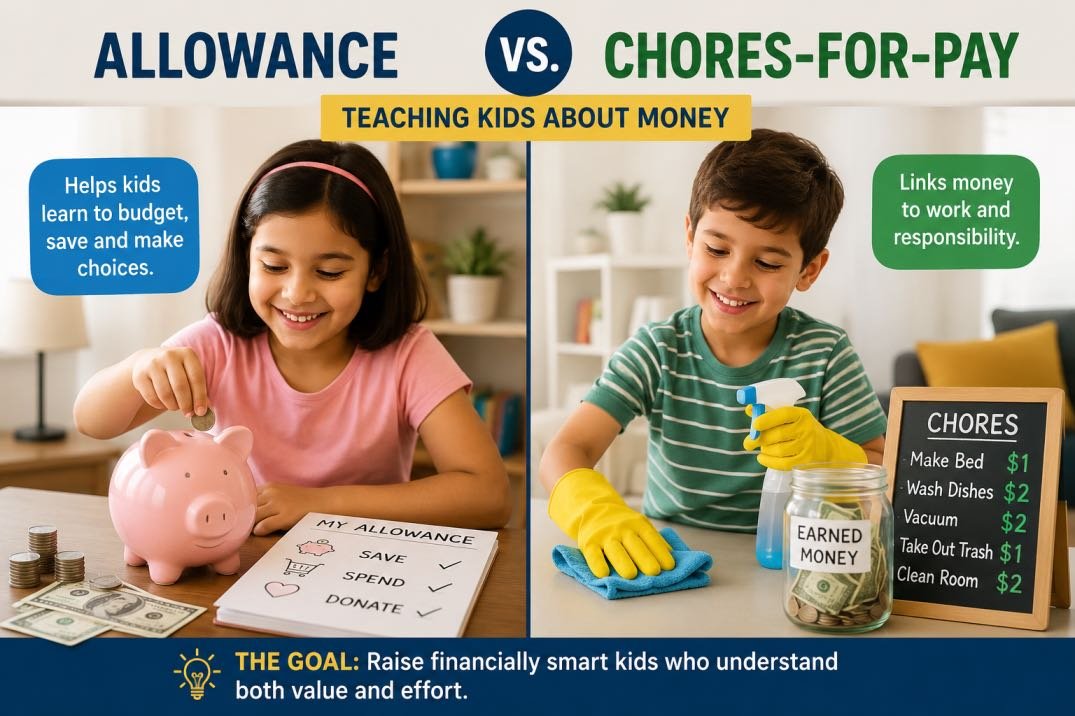
Quick answer: A flat, unconditional allowance tends to teach money management skills, budgeting, saving, spending decisions, more directly, while paying for chores can inadvertently teach kids that helping around the house is optional and only worth doing for payment. Many families find a hybrid works well: a base allowance plus optional extra tasks for additional pay. Our early approach paid a small amount for each specific chore completed, which seemed like a reasonable way to combine money lessons with household help, but it created an unexpected problem fairly quickly.
My son started declining to help with anything not explicitly tied to payment, treating basic household participation as something optional he could simply opt out of if the price wasn’t right, which wasn’t at all the lesson we’d intended to teach.
What I Tried First (and Why It Didn’t Work)
We assigned a specific payment to each individual chore, cleaning his room, helping with dishes, feeding the pet, which worked for actually motivating those specific tasks but created a transactional mindset around household participation more broadly.
This approach also meant money conversations became entirely tied to negotiation over chore payment, rather than broader, more useful conversations about budgeting, saving, or making genuine spending decisions with a fixed amount of money.
Switching to a Flat Allowance
We moved to a flat, unconditional weekly allowance, separate entirely from basic household chores, which we now frame as a normal expectation of being part of the family, similar to how we approach chores more broadly (see our related guide on chore chart by age) — genuinely expected participation, not a paid transaction.
This single change removed the transactional mindset around basic household help almost immediately, since chores were no longer up for negotiation based on payment, while the flat allowance itself became a genuinely useful tool for teaching budgeting and spending decisions.
Adding an Optional Extra-Earning Layer
We did add a small set of optional, bigger tasks, beyond normal expected chores, that can earn additional money if he chooses to do them, which preserved some of the original motivation for extra effort without undermining the basic expectation that normal household participation isn’t optional or dependent on payment.
This hybrid approach has given us the best of both original goals, teaching genuine money management through the flat allowance, while still offering an optional path to earn extra for kids who want to take on more than the basic expected participation.
| Before (Chores-for-Pay Only) | After (Flat Allowance + Optional Extra Tasks) |
| Basic chores treated as optional/negotiable | Basic chores expected as normal family participation |
| Money conversations centered on chore negotiation | Money conversations centered on budgeting and spending |
| No consistent money for saving/spending practice | A consistent flat amount for genuine money management |
| No path to earn extra beyond assigned chores | Optional bigger tasks available for additional earning |
If you only remember one thing:
Separating basic household chores from money entirely, treating chores as normal family participation and using a flat, unconditional allowance for genuine money management lessons, removed the transactional mindset around chores while still teaching real budgeting and spending skills.
Should kids be paid for doing household chores?
Many families find that separating basic, expected chores from payment, while offering optional extra tasks for additional earning, works better than paying for every single chore, which can create a transactional mindset around normal family participation.
What does a flat allowance actually teach that chores-for-pay doesn’t?
A flat, unconditional allowance gives kids a consistent amount to practice genuine budgeting, saving, and spending decisions, separate from the unpredictability of chore-based earning.
Is a hybrid approach better than choosing one system exclusively?
Many families find a hybrid, a flat base allowance plus optional extra tasks for additional pay, offers both consistent money management practice and continued motivation for extra effort beyond basic expectations.