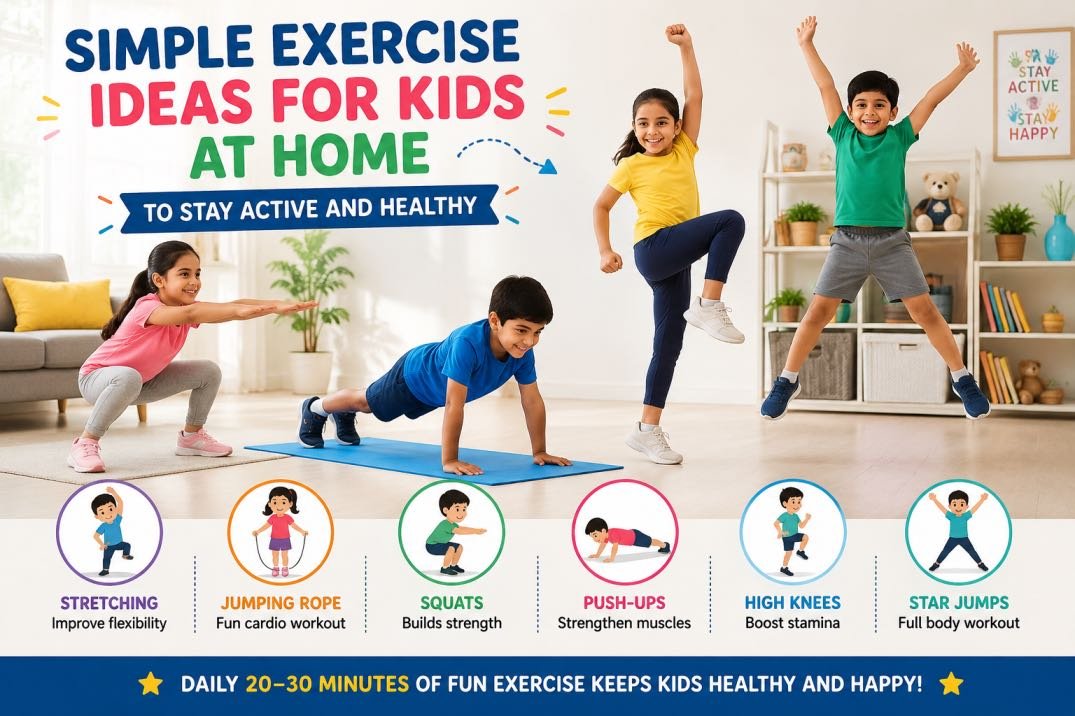
Simple Exercise Ideas for Kids at Home to Stay Active and Healthy
Quick answer: Good simple exercise ideas for kids at home include dance-along videos, animal walk games (crab walk, bear crawl), a simple obstacle course, jumping jacks races, and yoga poses turned into a game. Framing movement as play rather than formal exercise matters more than the specific activity chosen. My early attempts at getting my kids to exercise at home involved fairly direct instructions, do some jumping jacks, run in place, which were met with about as much enthusiasm as you’d expect from being told to do chores.
It took reframing the whole idea, from “exercise” as a distinct, somewhat boring task to genuinely playful movement woven into games they already enjoyed, before physical activity at home actually became something they looked forward to rather than resisted.
What I Tried First (and Why It Didn’t Work)
I initially approached home exercise the way I might think about my own workout, structured, somewhat repetitive movements with a clear set and rep count, assuming kids would respond to the same basic framework just scaled down.
This approach produced a lot of eye-rolling and half-hearted participation, since the framing itself, exercise as a discrete, slightly tedious task to get through, didn’t match how kids actually engage with movement, which tends to be far more playful and imaginative by nature.
Turning Exercise Into Genuine Play
We shifted to framing movement entirely as games rather than exercise, animal walks (crab walking across the room, bear crawling under a “cave” made from chairs), which get genuine cardiovascular and strength benefits disguised entirely as imaginative play rather than a workout.
Dance-along videos have also become a reliable go-to, since the music and choreography give kids something to actively engage with beyond just moving their bodies, and the genuine fun of it means they’ll often ask to do it again rather than needing to be convinced.
Building In Just Enough Structure
A simple, informal obstacle course, built from couch cushions, chairs, and whatever’s around the house, gives movement a clear goal and sense of progression, similar to how we’ve approached other indoor activity setups (see our related guide on best indoor obstacle course ideas for kids) — enough structure to feel like a real activity, without feeling like formal exercise.
We’ve also found that a bit of friendly competition, a jumping jacks race, seeing who can hold a yoga pose longest, adds genuine motivation without needing to frame it as “exercise” explicitly at all, since the competitive or playful element becomes the actual point, with the physical activity happening almost incidentally.
| Before | After |
| Structured exercise instructions | Movement disguised as imaginative play |
| Repetitive, adult-style workout format | Animal walks, dance-alongs, obstacle courses |
| No real motivation beyond instruction | Friendly competition and games as motivation |
| Framed explicitly as “exercise” | Framed as play, with exercise happening incidentally |
If you only remember one thing:
Reframing physical activity entirely as imaginative play — animal walks, dance-alongs, obstacle courses — rather than presenting it as formal “exercise,” is what actually got my kids genuinely enjoying and requesting movement at home, rather than resisting a task that felt like a chore.
What is a simple exercise activity for young kids at home?
Animal walk games, like crab walking or bear crawling across a room, disguise real physical exertion as imaginative play, making them genuinely engaging for young kids without feeling like formal exercise.
How much daily physical activity do kids need?
General guidance suggests at least an hour of activity most days for school-age kids, though this can be spread across shorter, playful bursts throughout the day rather than one continuous structured session.
Do dance-along videos count as real exercise for kids?
Yes, dance-along videos genuinely engage cardiovascular activity and coordination, and their playful, music-driven format tends to hold kids’ engagement better than more repetitive, structured exercise instructions.



2 Comments
Comments are closed.